See other sibling comments to yours, but you basically have named support contacts who would have been the human-in-the-loop ensuring that a situation like OP's can't happen.
I haven't spoken to them in like a decade, but they also offered other monitoring stuff like notifying you of likely phishing registrations, etc. And it's no longer novel now with options like Route53, but they used to be one of the only solutions with proper RBAC/delegation/audit logs.
You moved from the worst registrar to the second worst registrar. Cloudflare will call you up one day demanding an immediate payment of $150k and holding your domains hostage if you don't comply.
Cloudflare isn’t anywhere near being the second worst registrar. I’ve never had anything remotely similar to this occur, and I’ve had hundreds of domains with Cloudflare for years.
Whatever was really happening in that incident it seems clear that it was not a simple matter of having registered some domains with Cloudflare and then getting a shakedown for $100k+ because of that.
If anyone else chooses to read the post then I suggest skimming the comments (that are mostly hidden by default) as well.
The point isnt the apologists that pop up whereever CF gets mentioned, the point is that they more or less have a built reputation for deceptive loss leader marketing.
Maybe early/MVP product engineers should know better, but CFs own education materials do not teach you to expect that.
I have no financial or professional connection to Cloudflare as far as I know and that's partly because I'm not sure I like the way they operate and the level of control over everyone's access to the Web they now have. But if we're going to criticise then I think it should be on a reasonable and preferably objective basis. The claim I challenged appears to be the complete opposite of that unfortunately.
> Whatever was really happening in that incident it seems clear that
... CF for all their faults probably weren't the bad guy, when they discovered a "customer" absolutely taking the piss with capacity and doing incredibly sketchy things with domains to get around regulatory issues.
I have a courtesy hire car from a breakdown service at the moment with "unlimited mileage". I suspect they mean "unlimited mileage doing the sort of thing you do normally", and that "Unlimited, cool, I'm driving this thing from Scotland to Dagestan" would be met with opposition and a large invoice.
If you were in Scotland or Europe more generally, it'd be illegal for "unlimited mileage" to not actually be unlimited mileage.
If CF decides you're subject to an invisible limit which they won't even tell you and you have your domains at CF, they hold your domains hostage. Luckily, these guys had their domains somewhere else so they weren't hostage. Don't be the one who is.
Cloudflare didn't give them the option to quit hosting with CF and port their domains out. It held the domains hostage because the domains were registered through CF.
Yeah, thats FUD. Cloudflare hasnt called anybody demanding huge sums of cash and holding your domains hostage. As a registrar they're fine, dont play scammy scum upsell games (because they have a real business model that isnt just registration skim).
beautiful! my only issue was the trails are not consistent with the vertical speed -- it appears they curve even if the plane is descending (see the sfo arrivals and how they appear to be "stepping" down). Airloom solves this by not rendering trails until after the plane has moved.
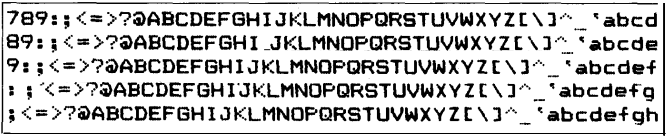
Something isn't right with this, though. I don't remember if there was a "wide" mode, but this font, while it feels very accurate, is somehow stretched wider than what would have been default. Here's an image of something from an MX-80 that looks more like what I remember: https://technicallywewrite.com/images/2024/07/epson2.png
(taken from https://technicallywewrite.com/2024/07/01/dotmatrix). Still, thanks for sharing this!
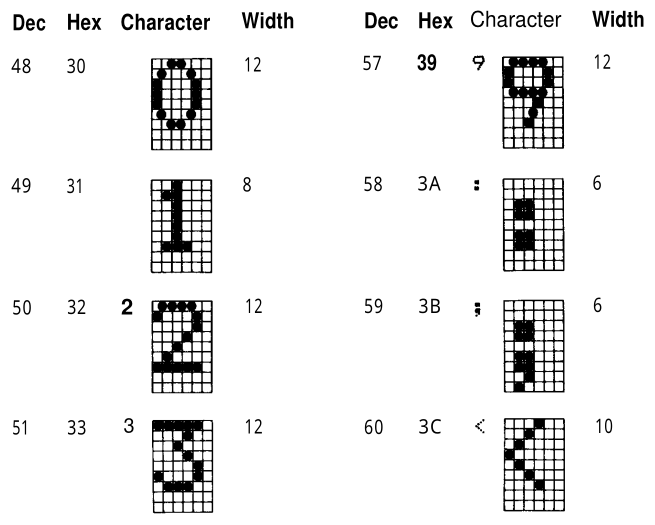
EDIT: Now I know what the issue is! Per the link above: "Like other impact printers, the Epson series of dot matrix printers used a 6x9 grid to arrange the dots for each letter. Dots could also be printed halfway between each vertical line on the grid, effectively providing a higher resolution of 12x9 for each printed character." Here's an illustration: https://technicallywewrite.com/images/2024/07/epson1.png
Ah, so the characters we’re seeing here are twice as wide as they would be when printed? Adding some CSS to compress the page horizontally looks a lot closer to the first image you shared:
It was a 1 x 9 print head and you could get 132 characters per line as well as the normal 80, plus variants such as 40 and 66 characters per line, where things must have been doubled up with the motor running at the same pitch, hence the 12x9 you refer to.
I only became familiar with the later FX-80, which was the same but different. I managed to get logos printed along with neat boxes around information from the extra characters it had in PCL.
I am sure NLQ was a selling point of the FX-80 but I would like to see how good it was on the MX-80. At the time printers from Epson, HP and Canon were miracles of engineering, more advanced than the computers they were connected to.
I usually printed my listings etc. with "condensed" fonts. They looked very nice. Even so, I can't remember that the non-condensed fonts should look that wide, when looking at the web page.. I remember something kind of like that, but not the standard mode.
I have an OKI Epson-compatible matrix printer somewhere in the man cave. The last time I printed anything on one was a Snoopy calendar generated by the Snoopy Calendar Fortran program. If I ever get the mess in the cave sorted out I'll get that printer hooked up again, to something. The 80's mini maybe..
I remember my Star LC-10 had multiple fonts with different widths. There was regular, condensed, wide and NLQ (Near Letter Quality). The latter looked like it had been written on a typewriter.
I had a Star SG-10, labeled as "Epson Compatible". (Mostly)
The Near Letter Quality was essentially double struck by making a second pass at a slight offset, with the corresponding increase in noise and print times.
There wasn't support for the printer in AppleWorks, so my first useful program was a BASIC thing that you could set the font in the printer and then reboot into AppleWorks to use either the 10 cpi, 12, 17(condensed) or the NLQ setting.
Star Micronics Gemini-10X to Xetec Super Graphix interface card to C64. The bane of my existence seemed to get the sprockets synced and eventually started wrinkling the paper after a few pages.
According to AI, Airbus places these switches on the overhead panel, so that alone would make it harder to inadvertently move them. Apparently, Airbus "protections do not extend to mechanical or FADEC‑controlled systems like the engine‑fuel shutoff valves. If you deliberately pull and flip the ENG MASTER lever to OFF, the FADEC will immediately close the LP and HP fuel valves and the engine will flame out. If you then return the lever to RUN (and you meet relight conditions), it will automatically relight."
As another commenter said the Airbus engine start/stop controls are located behind the thrust levers, and according to the A350 operations manual which I got my hands on there are two conditions required for the FADEC to command engine shut down: Run switch to off, thrust lever to idle.
So if that's correct on an Airbus aircraft you can't just switch off the engines when they're commanded to produce thrust. This also seems to be backed up by the difference in the guards for those controls in the Airbus cockpits.
Maybe as the PIC was guarding the lower end of the throttle he rested the rest of his hand on the panel cover below the throttle and, while pushing forward on the throttle, let the side of his hand slide down right onto the switches, the likeliness of which would have been exacerbated by a rough runway or a large bump. It's unlikely the left and right part of his hand would have contacted the cutoff switches at the same time, hence the delay between the two switches being actuated. Of course this relies on the safety locks not working properly, which is something that hand been reported.
Nope. First of all, the FO was the “pilot flying” and thusly controls the throttle. The fuel shutoffs are on the left side, well clear of the range of motion throttle operation for the right seat.
If the Captain were controlling throttles, it for some reason he could contort his wrist to accidentally open the red cutoff switch guards, the switches themselves move in the opposite direction of the pivot of the switch guard. And to have that happen to both switches — one second apart. That would be astronomically (not to mention anatomically) improbable: you can’t have your hand on the throttle and also be dragging your arm on the switches unless the pilot has an extra elbow.
Further more, the 787 has auto throttles, at takeoff the pilot advances the throttles to N1, then all the way through climb out the auto throttles control the throttle unless manually disengaged.
Also a “bumpy runway” wouldn’t do anything because if those switches were activated on the roll out, the engines would shut down almost immediately: that’s the point of those switches to kill fuel flow immediately not minutes later.
And no there isn’t a report of the safety locks not working properly on the 787. The report to which you are referring was in 2018 and that was an issue with a very few 737 switches that were improperly installed. The switches didn’t fail after use, they were bad at install time. Exceedingly unlikely that a 787 was flying for 12 years with faulty switches. (Notwithstanding the fact they they are completely different part numbers.)
The 787 that crashed had been in service since 2013 which means if that were a problem in that plane, however unlikely, with hundreds of thousands of flight hours, inspections, and the 2018 Airworthiness Bulletin — that problem would have been detected and corrected years ago.
You are wrong. The fuel shutoff switches are directly beneath the throttle levers, and they move down to cutoff, which is exactly the direction a hand beneath the throttle would move to accidentally switch them to cutoff.
Secondly, while the FO was flying the airplane and thus would have control of the throttles during rollout, the captain would certainly have his hand beneath the throttles in an observer position during at least part of the takeoff. And during takeoff, procedure would have the captain take over control of the throttle levers until rotation while the FO handled the yoke with both hands.
blancolirio[0] has two excellent video examples of 787 takeoffs within the cockpit showing FO-pilot takeoffs and both officers' actions during takeoff.
Page 10 of the Air India preliminary report[1] shows a picture of the fuel cutoff switches -- clearly labeled "FUEL CONTROL" with "RUN" in the up position and "CUTOFF" in the down position -- directly beneath the throttle levers.
This. There are no flip-covers on the switches in any of the photos I've seen. Additionally, it looks like the side guards are only on the left and right sides of the pair of cutoff switches, not in-between the two switches. So if one bumped one switch, seems like it would be very easy to bump them both.
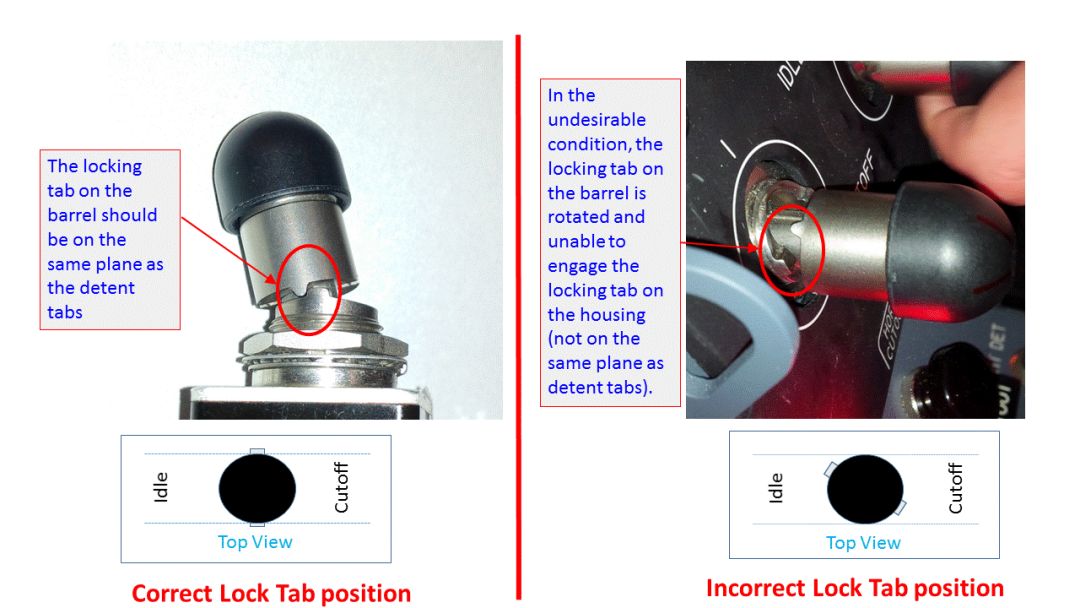
There's a metal nib on the switch and switch housing preventing it from being bumped. There's also a spring holding it down so it can't bounce up. The distance and required force makes switching them at the same time impossible, thus the 1 second difference. This was absolutely an intentional act.
One can easily switch them with two fingers at the same time.
I tried (with similar switches.): Works. If the locking mechanism fails, even unintentionally.
Getting loose, wristworn jewlery snatched and then pull: Works.
My question to Boeing is:
Why did you cover the neighbouring (stabilizer cut-off, IIRC) switches with red springloaded flip-covers, but not the fuel cut-off switches?


reply