This is basically where I (and I imagine many others) have landed with the telephone. Anyone not in my contacts goes to voice mail. Made my phone usable again.
still not many are doing it with emails. but great point, tough we all still have to pick unknown calls here and there as we expect someone, so with the email screener it's even better, as each email has a sender.
That is the drawback - sometimes important calls come from someone not in my contacts (like an emergency where someone borrowed a phone, or a contractor trying to call you.) Still, the beauty of voice mail is that, if the caller is really trying to reach you, they will leave a message. Some random number with no message is almost assuredly spam. That model wouldn't work with email (you would need an equivalent real-time notification of an email going to a spam folder, then the user would have to decide to send to spam or not send anything.)
Anyone without caller id is also suspicious. Emails have a sender, but it is also about as reliable as a caller id (i.e. not very) when it comes to identity.
True for human generated results too - how many "proofs" of Fermat's Last Theorem were proposed then discarded when a mistake was found, before Wiles?
2. Lack of proper attribution and violation of copyright
I have trouble understanding the difference between a human reading and digesting copyrighted materials (i.e. "training") and AI training. As long as either case doesn't reproduce this material word-for-word without attribution (which is why we have a word for this - plagiarism.) OK, maybe an electronic thinking tool makes plagiarism easier if you are careless. A power saw is more dangerous than a hand saw, too.
3. Dependence and inequality
Any fancy automation tool brings this risk. Is a Matlab subscription or access to a data center "inequitable"? And yeah, if you live in a place where you need a car, then you have a mobility dependence. You can still walk, but it isn't practical.
4. Overhyping of results
I don't see a difference between human or AI generated here, although the newness of AI does lead to people being more interested at the moment. The shine will wear off eventually.
5. Loss of autonomy
I just don't understand why AI is a problem here - the "autonomy" here is about who sets what topics are interesting in mathematics. Is it because every amateur now has a new powerful tool that once only existed in the brains of a few adepts? So they (or AI itself) might have input into what problems are important?
So overall I think this isn't a very effective list of risks. Everyone is nervous that the unique thinking abilities that set mathematicians apart (and I completely get this as a physicist) are being eroded. Until the reliability of the output of AI systems improves by several nines, we need humans in the loop to make sure the output is correct (Point 1.) But given that AI is improving rapidly, extrapolation to the day where humans are effectively out of business is now something that needs to be considered. Just declaring we need humans to do mathematics research isn't going to be enough if that day ever arrives.
The Bene Gesserit tried to solve alignment through their breeding schedule, but Lady Jessica threw a wrench into it by bearing a son (Paul) out of love for Duke Leto. Paul wasn't aligned with the Bene Gesserit, and hilarity ensued.
So I agree, I don't see why thinking machines are a worse alignment problem than enhanced humans. See also the Wrath of Khan.
I try not to think too deeply about it, or I won't enjoy the story. How could a society have gravity suspensors, "shields", and lasguns, but no advanced computing capability somewhere? And why use swords/knives for fighting, when projectile weapons are so much more deadly? I still love the books, but I have friends who can't enjoy the Dune world due to its many contradictions.
Edit: I realize that "shields" supposedly made ordinary projectile weapons ineffective - but they had advanced drone technology (e.g. the assassin drone used against Paul, which was also stupid)
They had advanced computing, a whole region was full of it: IX.
The rest of the empire was too feudal and too religious to dabble into advanced technology. And the other players (the BG, the Tleilalxu, the Guild) were against it as well.
What good are drones, except as weapons of assassination? Can't use them in an conventional war, there are shields. And they're very expensive, remember, the Great Houses don't have advanced manufacturing capabilities (that's IX). And, finally, there are no great wars in the empire, most houses keep to their planetary fief; the Baron's attack on the Atreides' forces on Dune was an exception. It was also mindbogglingly expensive, 80 years of spice profit.
>What good are drones, except as weapons of assassination? Can't use them in an conventional war, there are shields.
Presumably a drone could get close enough to push a blade through the shield (maybe use a rocket booster or some other advanced "suspensor" tech) at low-ish speed (a knife would have to travel through the shield on the order of a human reaction time, otherwise even knives wouldn't work. That's about 0.1s/0.1 m, so 1 m/s - ish.)
if it moves slow enough to pass a shield, it moves slow enough to be easily dispatched. And remember, no autonomous behaviour, there has to be human operator. And it's very expensive. It just doesn't scale.
OK we are really nerding out here but I just can't resist :)
The propelled blade weapon doesn't need a control system in the "shape of a human mind" to be effective. A very simple control system would work. If they have ornithopters, then they have control systems. The blades could even work like hawk talons (so an ornithopter drone falling on a shielded fighter, then springing what is effectively a pointed metal trap.)
But more importantly, you are right that if the weapon moves too slowly, then you could just get out of the way. That's true of any weapon, no matter how it is propelled. That's why I said above you have to be able to penetrate a shield faster than a human reaction time, otherwise no weapon would be effective.
You're right about the suspension of disbelief necessary to enjoy the story, of course. I just felt like nitpicking because people seem to take the Butlerian Jihad seriously as a possible way to contend with AI in our real world, which I think asks too much of the story.
> Paul wasn't aligned with the Bene Gesserit, and hilarity ensued.
Hah, great perspective and I agree. Even normal humans are so difficult to align, no wonder it went wrong with a guy with prescient powers.
I'm in my sixties and reflect sometimes on how much freedom I had as a kid, and why things have changed so much in terms of risks parents are willing to accept.
One correlation with "safetyism" this article doesn't mention: the rise of the two income household (https://www.pewresearch.org/social-trends/2014/04/08/after-d... for the US; the UK appears to be similar.) In reality when we kids were running wild about the town, someone was watching us out their windows. If we got into (or more likely caused :) ) a problem, adults, usually a housewife, would show up quickly from somewhere. Even when we were off in the woods there was a sense that we could find a house where a grown-up would help us if needed (like if some kid's little brother ruptured his spleen on a dare, which actually happened.)
Nobody would call Child Protective Services - you knew it was little Billy who threw that rock that hit Jimmy, so-and-so's kid. You would tell Billy's dad, who would make sure he didn't ever do _that_ again, and that would be the end of it. Now I imagine police and lawyers would be involved. It seems we don't have the informal social connections any more, which were largely driven by someone just being around.
The above link BTW shows that "only" 50% of mom's were stay-at-home in the 1970's. In my specific time and place, many of the moms who did work outside the home had jobs that revolved around the school schedule (i.e., working at the school, or some work schedule that allowed them to be home when the kids were not in school.) The ones with full time jobs like my single mother, supporting three kids through full-time work, were a rarity back then. Maybe my brothers and I had excessive freedom because there simply wasn't anyone to watch over us - fortunately we all turned out more or less OK :)
I'm in my early forties and both my parents worked (as did all my neighborhood friend's parents) and we still spent a lot of time wandering around. Honestly I think people are really overthinking this. We spent a lot of time wandering around outside because we were bored. Now kids have an endless well of entertainment to choose from so staying at home is a much more appealing option. It's always tempting to romanticize your childhood but if I'm being honest, most of that time wandering around outside I was bored out of my skull. I was just marginally less bored than I would have been sitting at home.
Late 40's now. Both of my parents worked in the 80's-90's and I wandered up to 10 mi (16 km) away when I was 13. I was cycling up and down fire roads in the mountains. They never gave two shits how far I went so long that I wasn't in the house all the time but was back before dinner or sunset.
It's not necessary, but it might be necessary for the child to believe that's a possibility. It's like armies. The presence and the possibility do most of the work. My grandfather didn't beat his children, but e.g. spanks and being hit on the butt by a belt were permissible by society. He didn't do that AFAIK, but the children knew it was possible, and a single look from him sufficed to get them to stop misbehaving.
He's very loved by them, BTW. I didn't meet him, but they always talk with admiration of him.
It might be like brakes. Some people abuse the brakes for their own self-satisfaction to e.g. brake-check others, others brake hard every time they need to come to a stop (e.g. intersections) because they don't know otherwise, and then others make it seem like the brakes don't even exist as the car glides without disturbance to the point that you might find it normal to have a drink from a open cup throughout. It's always necessary to have the brakes, and always permissible to slam on them in case an emergency is happening, but they're ideally used sparingly and softly. They should ideally be made to seem like they don't exist, even though everyone knows they do.
Dude, you're breaking the analogy. Imagine an ICE car from the 90s. It's not about what technologies you're using. It's about the skill and intent with which you use the brake pedal (considering it the only form of braking).
Can you elaborate on how Billy's dad would make sure he never threw rocks at people again?
FWIW, I grew up in the Midwest in the 80s and was subject to corporal punishment. Also witnessed only the black children being spanked at school in the South Eastern US.
Sure - having raised kids myself, and never once hitting them, there are lots of ways to memorably punish a kid. First and foremost, kids really respond when their parents get upset. They remembered when I was visibly angry with something they did. Throw in some "I am so disappointed with you" from the other parent, maybe grounding them or taking something away they want, and we have something a kid would like to avoid in the future. Like any punishment, it can't be used too much or it loses effectiveness (so if you blow up at your kids constantly all you are doing is funding a future therapist's income...)
FWIW, teachers in my (basically all-white) school in the Northeast US in the 70's and 80's would occasionally paddle kids for egregious behavior (like doing something dangerous or open insubordination.) In my low-N observations, it had dubious effectiveness. Kids who were generally good but just messed up once appeared to be "scared straight", although of course I can't say if it was more effective than non-corporal punishment. The sudden shock and embarrassment of being paddled seemed to be effective though. If the kid was a "behavior problem" paddling wouldn't fix the underlying issues.
Also, if you were punished at school, you could expect to be punished at home, if your parents ever found out. Most parents back then would immediately side with the teachers; that's something else that has really shifted in the last half-century. Today, parents are involved to the point of interference, at least in the more affluent areas.
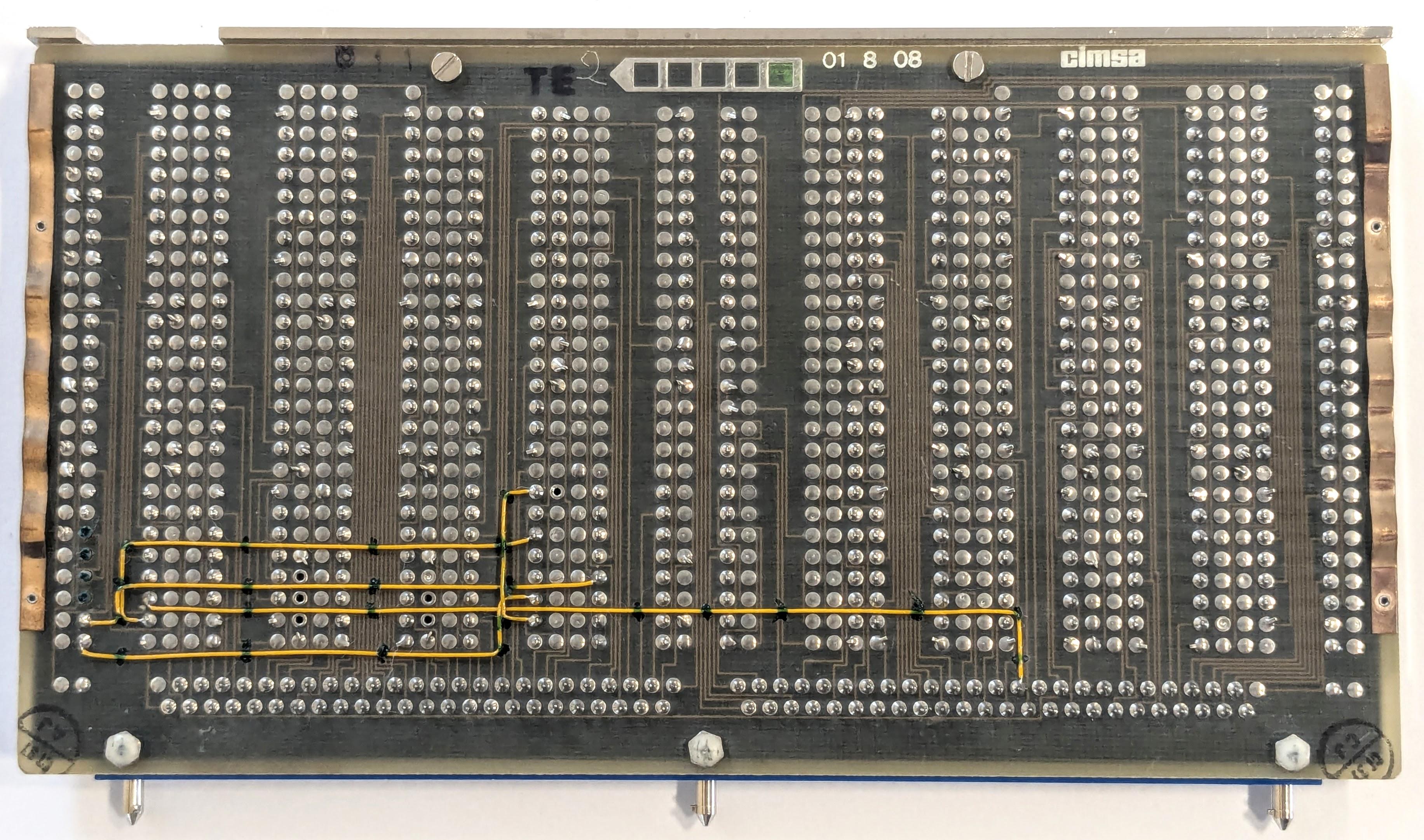
The PCB construction is curious (which you say is multi-layer) - why use a grid of 0.1" holes? Is that so it could be easily jumpered? Can you tell if the traces run through the holes or between them?
I don't have the patience to reverse-engineer these types of boards, but I do find them really interesting to think about. CAD was just getting started (I just looked up that Gerber format was released in 1980) so I wonder if the masks were hand-drawn.
The grid is 0.1" holes because that's the spacing of most components; it's a bit like perfboard. If you're asking why they used a grid instead of a normal-style PCB, I'm not sure. It probably makes manufacturing the boards much easier since you can drill the holes with an assembly line rather than one at a time. The traces go between the holes; the traces are very narrow, so two traces can fit between a pair of holes. That's probably the tradeoff, that your traces need to be very precise and you probably need more layers because of all the holes in the way. The layout was probably done with CAD; PCBs with CAD go way back. IBM was doing circuit boards with CAD back in the early 1960s, using a flying spot of light to draw out the PCBs on photoresist.
> The PCB construction is curious (which you say is multi-layer) - why use a grid of 0.1" holes?
The claim is multi-layer, but I seriously doubt that. I suspect that these are two-layer boards.
And if that's the case, the pattern is most likely because the holes precede the etch. And possibly precede the copper deposition so that the copper deposition can coat the insides of the holes.
And the holes are in a regular pattern because CNC simply wasn't a thing yet. You probably had some fixed array of drill bits that were used to make the holes in a very strict fixed automation fashion.
Why do you doubt that these are multi-layer boards? IBM was making four-layer boards exactly like these in 1964 for the System/360 (signals on the top and bottom layers, power and ground in the middle layers).
IBM was using flip chip in their mainframes in the same timeframe, too. That doesn't mean usage was widespread. This was 1970-1975, after all.
In addition, 2-layer has some big advantages over 4 layer for reliability (won't delaminate under launch vibration, for example)--which is an issue in aerospace.
Besides, even if it were 4 layers, the issue is still that drilling holes in a non-regular pattern simply wasn't something that could be done easily 1975.
I don't want to be rude, but I am not following your argument here. a) The computer that I'm examining is from 1980, not 1970, so I don't know why you're changing the time period. b) I have the circuit boards in front of me. They have more than two layers. c) You linked to a photo of a completely different computer. d) Drilling PCB holes in a non-regular pattern was trivial in 1975 and how most PCBs were built. Look at the S-100 boards from the Altair 8800 (1974) or look at the Apple I circuit board (1976) for instance.
I mean, if you have the boards, then you obviously have the definitive answer about layers. Can't argue that.
As you point out, if they designed this thing in the late 1970s, there is no reason for those giant arrays of drill holes. PCB design was definitely past this point by then and it would have been a hideous waste of time drilling all that just to fill them all up with wave soldering. It also blocks your routing terribly.
However, I assumed that this was likely a port of something from much earlier given the enormous lead times that aerospace requires (especially in the 1970s). There is absolutely no good reason to leave those extra holes which can become an assembly mistake otherwise.
"The Mitra 125, sometimes called "Mitra 15M/125" succeeded the Mitra 15 in 1975" That is the design that got used for the Spacelab Metra 125 MS in 1980, right?
I presumed that this was a port of a board which was a port of a board which was a port of a board given that design was obsolete even in 1975 since they apparently switched to the AMD bit slice processors even that far back.
And looking at Altair 8800 boards, you can see that the landing pads were very much NOT trivial, and look like they might even be hand drilled given the poor registration. Excellon/Esterline machines were still not that common outside of very high volume in 1975. By the time the Apple II came online a couple years later, though, the Excellon drilling machines were pretty commonplace.
>As you point out, if they designed this thing in the late 1970s, there is no >reason for those giant arrays of drill holes.
Yeah, this was precisely what my original question was about. Weird claims in this thread - we had multilayer boards with CAD layout in 1980, but can't drill through-vias in anything but a complete grid pattern? These are low-volume production boards too, trivial to drill an arbitrary pattern. (Edit: Obviously we did have multilayer CAD designed boards in 1980...)
My own (tongue-in-cheek) guess: someone prototyped this circuit on a perf-board with point-to-point soldering, then handed it off to a too-literally-minded junior engineer to do the PCB layout :) Unless there is some aerospace thing I am missing for having the full hole grid available...maybe they thought it was a weight savings?
Yes, I agree superconducting-ring-as-battery isn't very practical at all. I was shocked by how little it can store. I was picturing that it could just become like a super super massive power line and store as much as you want, electrons are small, are they not going to fit? I thought any number of electrons will fit pretty much, it'll just keep increasing the current racing through it (not saying my EE training is the best), which I thought would be a lot. I didn't know there is a heavy magnetic component that is the limiting factor of all this. In some ways I guess it is still a lot of storage, but it isn't useful for anything. Still cool.
It seems Sam Altman has the same suspicion, based upon his response:
> There was an incendiary article about me a few days ago. Someone said to me yesterday they thought it was coming at a time of great anxiety about AI and that it made things more dangerous for me.
Unlikely – no one is starting off undecided, then reading one article in The New Yorker and then committing this. And it's a slippery slope to tie it to legitimate criticism.
Disclaimer: I have no association with any AI company and have never met Altman or any of the other top AI scientists.
The real question is: can anyone be trusted if the fever dreams of super-intelligence come true? Go ahead and replace Sam Altman with someone else - will it make a difference? Any other CEO is going to be under the same overwhelming pressure to make a profit somehow. I think the OpenAI story is messier because it was founded for supposedly altruistic reasons, and then changed.
Methinks many of Altman's detractors protesteth too much. He's doing his job as it is defined (make OpenAI profitable.) Nothing of substance in this article seemed to make him exceptionally "sociopathic" compared to any other tech CEO. It goes with the territory.
What depressed me most is that trillions of dollars are being raised for building what will undoubtedly be used as a weapon. My guess is the ROI on that money is going to be extremely bad for the most part (AI will make some people insanely rich, but it is hard to see how the big investors will get a return.) Could you imagine if the world shared the same vision for energy infrastructure (so we could also stop fighting wars over control of fossil fuels and spewing CO2?) A man can dream...
"Leonie Mueck, formerly the chief product officer of Riverlane, a Cambridge-based quantum startup, said Google’s statement did not necessarily suggest there would definitely be a working quantum computer capable of breaking encryption by 2029."
Basically more worried about decrypting currently stored, encrypted information with a future quantum computer. My guess is most critical encrypted files use symmetric encryption (e.g. AES256) and won't be cracked with a quantum computer any time soon (or really, ever.)



reply