All your comments are painting archive.today as an innocent victim in all this, but in addition to the DDoS, they have been caught modifying archived pages as well as sending actual threats to Patokallio [1] which in my opinion seem far worse than the "doxxing".
Just the fact alone that they modified archived pages has completely ruined their credibility, and over what? A blog post about them that (a) wasn't even an attack, it is mostly praising archive.today, and (b) doesn't reveal any true identities or information that isn't already easily accessible.
From my perspective at least, archive.today seems like the unhinged one, not Patokallio.
There are only two posts about archive.today on the blog, and one of them only exists because archive.today started DDoSing them. I fail to see how you could consider the entire blog to be a "harassment campaign", especially considering that the original blog post isn't even negative, it ends with a compliment towards archive.today's creator.
I believe that is why "escalating safety" and "secure" were written in italics in the comment. Those are the terms Google would use, not necessarily the truth.
Are you saying that opting for a beyond burger patty instead of a beef patty is going to "poison and destroy" your health? That's a bit of a stretch no? Are they really any worse for you than a regular burger from a fast food joint or something?
"here" in that comment is not referring to any specific scenario. It is referring to the problem discussed in the sentence immediately following it, that public prediction markets can shape the outcome of the events they are predicting.
The "magic" of React though is in its name, it's reactive. If all you're doing is creating static elements that don't need to react to changes in state then yeah, React is overkill. But when you have complex state and need all your elements to update as that state changes, then the benefits of React (or similar frameworks) become more apparent. Of course it's all still possible in vanilla JS, but it starts to become a mess of event handlers and DOM updates and the React equivalent starts to look a lot more appealing.
Transcribing locally isn't free though, it should result in a noticeable increase in battery usage. Inspecting the processes running on the phone would show something using considerable CPU. After transcribing the data would still need to be sent somewhere, which could be seen by inspecting network traffic.
If this really is something that is happening, I am just very surprised that there is no hard evidence of it.
The vast, vast majority of Windows users don't know their laptops are encrypted, don't understand encryption, and don't know what bitlocker is. If their keys weren't stored in the cloud, these users could easily lose access to their data without understanding how or why. So for these users, which again is probably >99% of all windows users, storing their keys in the cloud makes sense and is a reasonable default. Not doing it would cause far more problems than it solves.
And the passphrase they log in to windows with is not the key, Microsoft is not storing their plain text passphrase in the cloud, just to be clear.
The only thing I would really fault Microsoft for here is making it overly difficult to disable the cloud storage for users who do understand all the implications.
> The vast, vast majority of Windows users don't know their laptops are encrypted, don't understand encryption, and don't know what bitlocker is.
Mate, if 99% of users don't understand encryption, they also don't understand that Microsoft now has their keys. You can't simultaneously argue that users are too thick to manage keys but savvy enough to consent to uploading them.
> If their keys weren't stored in the cloud, these users could easily lose access to their data without understanding how or why.
As opposed to losing access when Microsoft gets breached, or when law enforcement requests their keys, or when Microsoft decides to lock them out? You've traded one risk for several others, except now users have zero control.
The solution to "users might lock themselves out" is better UX for local key backup, not "upload everyone's keys to our servers by default and bury the opt-out". One is a design problem, the other is a business decision masquerading as user protection.
> The only thing I would really fault Microsoft for here is making it overly difficult to disable the cloud storage for users who do understand all the implications.
That's not a bug, it's the entire point. If it were easy to disable, people who understand the implications would disable it. Can't have that, can we?
> Note: This does not change the rounded corners of individual app windows. It only restores the straight silhouette at the edges of your display.
My display does not have rounded corners. I am on macOS Tahoe using external monitors. I know that newer macbooks have rounded display corners, but those are rounded at the hardware level afaik, those corner pixels simply don't exist. And besides that, the medium article linked in the repo specifically talks about external monitors. Does anyone have an example of what this program is actually meant to fix?
EDIT: I downloaded and compiled it myself to see. All it does is add a black border around your whole screen. Here is a screenshot: https://i.imgur.com/7XWAwxz.jpeg
Again, I don't have rounded corners on my display in the first place, but if I did I suppose this would hide them. At the cost of losing the whole edge of my display, lol. I don't see why anyone would actually use this, especially since it cuts off half the menu bar.
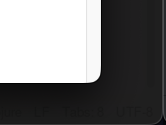
I had not noticed the rounded corner in the edge of my screen until now because I use a dark background and usually have some window maximized. This is a screenshot without this tool:
This screenshot shows the bottom right corner of my left monitor and a small slice of my right monitor. The light thing is the rounded corner of my browser window.


Just the fact alone that they modified archived pages has completely ruined their credibility, and over what? A blog post about them that (a) wasn't even an attack, it is mostly praising archive.today, and (b) doesn't reveal any true identities or information that isn't already easily accessible.
From my perspective at least, archive.today seems like the unhinged one, not Patokallio.
[1] https://arstechnica.com/tech-policy/2026/02/wikipedia-bans-a...
reply