Easier if you have a vast domestic flight market (US, China, etc), but not really practical if you're flying across borders, which is the base case in Europe, much of Asia, etc.
With traditional outlets you also inherit the whole legacy mess of competing standards for power mains. You don't want to feed 240V to a NEMA 1-15 outlet and melt someone's device mid-flight.
I do wonder if in some far future we'll just replace wall outlets with USBs for ordinary appliances, reserving traditional outlets for major power draws like stovetops, HVAC, industrial equipment etc. Maybe planes are the vanguard of this future?
They exist but are insanely unsafe. It would be ten kinds of illegal to install a socket like that in your home under any code I've ever seen.
It's already difficult enough to prevent people from making contact with the live parts when you're dealing with a plug and socket actually designed for each other. There's no hope in hell when you have ten extra holes.
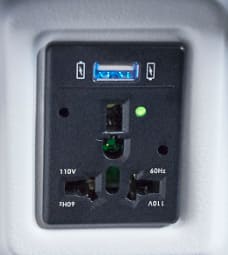
Because it's completely impossible to prevent people from being able to touch a live contact in a socket that must accept many different types of plug. Safe sockets firmly grip the plug they are designed for. This socket cannot, since it must be willing to accept anything you stick in.
Without being able to grip any individual plug's prongs, any actual plug plugged into the socket will always hang from it. This exposes the top of the live contacts, now flowing with mains (!!) power.
Look at the image above. Note the sheer size of those bottom holes, and remember that the socket can't firmly grip anything (compare the narrow US/Japanese holes, the diagonal Australian/Chinese holes, the circular European holes, the outer British holes - all overlapping but in different places). You are basically guaranteed to get exposed contacts.
This is just bizarrely dangerous on a transcontinental flight where you might be asleep, covered in blankets, etc. Given that this kind of socket would be illegal to install in your own home under most electrical codes, I have no idea why it's fine on a plane.
(And that's without getting into how this provides a completely incorrect voltage to most of the plugs, or how it encourages folks to try to shove non-compliant plugs into all that spare room, or the existence of plugs like Argentina's, that will fit but will be electrified on the wrong prong, etc etc)
I don't have need to look at this image, I've used this outlet safely plenty of times. I've helped other passengers use them as well. I've never seen a plug "hang" from it. In fact they usually are so firmly attached I have difficulty removing them.
You're argument about "exposed contacts" is absurd. The entire design of the US plug is exposed contacts. Anyone can and will find a way to use them in an unsafe manner. We allow people to eat with steak knives, despite them being able to cut their own jugular vein with them.
This socket does not provide "half" the power. It provides around 110 VAC to most outlets. Almost all devices you are going to be using are rated for 90 VAC-240 VAC. The frequency range is wide too, 47-63 Hz. Some of them work all the way up to 277 VAC as a rated voltage. The actual socket is incredibly complex and monitors for the presence of a load & the total current. Have you ever noticed the flight attendants know exactly who is using the plugs at what time? If you actually plugged a 240 VAC angle grinder into this plug, it would just turn off immediately.
This socket would be explicitly legal to install in almost any jurisdiction in the US so long as it has the right engineering documents. Equipping your home with these outlets would be so many orders of magnitude safer than normal wiring, although you could not run devices like a vacuum cleaner or a large appliance.
> You're argument about "exposed contacts" is absurd. The entire design of the US plug is exposed contacts. Anyone can and will find a way to use them in an unsafe manner. We allow people to eat with steak knives, despite them being able to cut their own jugular vein with them.
This is an absurd argument re electrical safety. We spend enormous time and effort idiot-proofing consumer-facing electrics, and for good reason, consumers are idiots, but even then they don't deserve to be electrocuted by mains power. "You eat with stake knives so you may just as well run barefoot through razor blades" is not a good faith argument.
> Almost all devices you are going to be using are rated for 90 VAC-240 VAC.
For a narrow range of modern tech devices with adapters, sure. For the average electrical appliance that people grey import from Alibaba or buy roadside in Kuala Lumpur?
"Almost all" - how many percent, exactly? Are you just thinking of your iPhone charger? Or are you thinking about some cheap night light that some mum is going to plug in because her kid is scared to fall asleep without it, or some Soviet-grade portable hand heater that some elderly babushka carries around with her?
This is typical engineer blindness. "Well the elderly semi-literate Russian babushka should obviously have known that her GOST 7396 space heater from some souk in Dushanbe was not one of the devices I was imagining when I put together my utterly-non-compliant Frankenstein socket..." Really? Why? Is that going to be persuasive to anyone?
> Some of them work all the way up to 277 VAC as a rated voltage.
What's even your point here? That high voltage devices... exist? What does that have to do with anything?
> This socket would be explicitly legal to install in almost any jurisdiction in the US so long as it has the right engineering documents.
And murder is explicitly legal to commit! (Terms and conditions apply, must be wearing camo and be pointed vaguely in the direction of the Strait of Hormuz.)
Your argument is almost entirely just trivia, and not even categorical trivia at that. 'Well, almost all devices do this...', 'some even work all the way up to... ', 'so long as the right documents are provided...'. These are not acceptable standards when dealing with the public. Consider that 'almost all' people do not steal, and yet we fill public spaces with security cameras.
When dealing with risk, you don't just consider likelihood and call it a day, you consider severity too. An event with potentially catastrophic consequences is something one takes seriously, even if deeply unlikely. There are probably tens of thousands of unsophisticated people in the air every second of every day, wanting to plug in their vape chargers and portable hand fans and god-knows-what-else.
When your Frankenstein socket - which quite explicitly adheres to no safety standard whatsoever - inevitably fails and causes property or health damage, and you're trying to explain why you ever thought it was a good idea to some safety auditor or, God forbid, a judge, how far do you think your steak knife analogy is going to take you? Or the curio that 277 V devices exist? Or the fact that this is illegal to install in a home, but you think you could get a special permit to do so - well, y'know, not after this incident, your Honour, but sort of abstractly speaking...
So how do most European airlines have just that on their intercontinental flights?
I don't think I've flown intercontinental without universal power sockets (accepts EU & US plugs, sometimes others, voltage info hard to find) in the past 10 years.
In some cases it's sadly still a premium cabin thing. I refuse to fly economy at this point, premium eco tends to be good enough to get power sockets.
What are you going to plug into a power outlet on an airplane that isn't dual voltage? A kettle or a toaster? I assume they have a way of preventing people from using those.
Almost all the international flights I've flown have had power outlets, always between 220V and 110V countries (heck, only Japan is 110V besides the US as far as I know).
I it works for China because they use (as an option at least) similar outlets to the USA (just ungrounded, pop).
Central/South America has a lot of 100-130 V too, I believe, but I don't have direct personal experience.
I find the standard voltages pretty interesting. The 230 V standard, for example, is mostly a lie. In reality, Britain and former British colonies tend to run on 240 V, and continental Europe/Asia/Africa tends to run on 220 V. The 230 V standard includes wide enough tolerances so that no one needed to actually change anything. I've never actually seen 230 V, the supposed standard, in real life.
I think 'assuming that the airline has a way of preventing' people from plugging in dangerous items is doing a loooooot of heavy lifting in your argument.
How, exactly? The airlines have absolutely no way to know what shoddy electrical device you bought god-knows-where you're plugging into mains power in their airtight travel-coffin, packed with hundreds of people, hurtling across some ocean.
> Almost all the international flights I've flown have had power outlets
Seems deeply unusual to me, but I won't dispute your experiences. I've flown internationally fairly often, and in my experience power outlets are rather uncommon (at least in the eastern hemisphere, flights to/from the Americas may differ, I haven't flown around there for many years).
Every flight I've been on had outlets that just let you plug in almost any plug. They have 115 VAC nominally supplied to them, although most chargers work just fine down to 90 VAC. Unless you're trying to run your cement mixer I don't think the peak voltage matters much.
Europe has a lowest common denominator plug, there are universal outlets (jack of all trades, master of none) that you already often find in airports, and each airline has a home country anyway.
Yeah, no. In EU+CH alone, you've got Schuko, French, reversed French (Czech), British (Ireland, Malta, Cyprus), and more rarely Italian, Danish and Swiss plugs. And those are just the current national standards as of 2026, ignoring anything non-standard or historic or foreign.
You can't just slap some ungrounded 240V Frankenstein multi-socket on the back of a plane seat and call it a day. Hell, you can't even do that in your own house in most developed countries.
That's before you even get to passengers plugging in their own $2 socket converters off eBay, half-inserted and loosely hanging off your already-lethal socket. And then these passengers wrap themselves in a synthetic blanket and go to sleep. What could go wrong.
We're not talking about some CRUD web app here, where being held together by sticky tape and prayer is fine and expected. This would actually kill people. Not exactly easy to deal with a smouldering corpse in the middle seat at 30,000 feet.
Low rise or high rise, (near) ground level (sub)urban PVs are going to run hotter because of the heat island and disrupted breeze, so panel efficiency and lifespan will take a non-zero hit too
Is that 20% of the solar energy, or 20% of the visible light, or some other spectrum fraction? It's easy to lose track of what part of the spectrum you're discussing.
> The conversion efficiency of a photovoltaic (PV) cell, or solar cell, is the percentage of the solar energy shining on a PV device that is converted into usable electricity
Some of the modern-day countries retained their five-digit postcodes from Yugoslav times (Serbia and Bosnia for sure, maybe a few more, I'm too lazy to check), some only got rid of the first digit which used to identify individual Yugoslav republics (AKA modern-day countries).
So I'd say it's highly likely they'd be delivered, as it's still mostly the same, though I should point out many cities changed names since. For like the most basic example, Montenegro's capital was called Titograd between WW2 and 1992, before it swapped back to being called Podgorica.
I've encountered a surprising number of forms where "Serbia" isn't an option, but Yugoslavia is, even in 2026. There's been a number of times here in the Netherlands where I had to pick Yugoslavia as my place of birth on official government forms because we were technically still Yugoslavia in '98 and not Serbia and Montenegro.
I have no doubts that snail mail addressed to Yugoslavia still exists and probably gets routed just fine
It would be logical if your date of birth changed the available options for country of birth to the set of countries that were contemporaneously recognized.
Considering how my parents still refer to that area of the world as Yugoslavia, I'm pretty sure the postal system will know how to route it. Will probably be escalated to a human for labeling though.
Granted, ccTLDs has been already going on for years before USSR change their pronoun to were. Mostly for email, no idea if ccTLDs found their use on BBS.
I can understand .su continuing because Russia pretty much took over everything that represent Soviet Union elsewhere (embassies, Security Council seat, etc) and other former Soviet states either support the continuation or indifferent. Yugoslavia continuation is more contentious topic.
> while eventually tapering and getting them off the glp entirely as the final end goal
It's an honourable goal but the evidence isn't great for that
> You still have to improve diet and regularly exercise anyhow
You don't have to. Should though.
When the drugs are working as intended, you'll lose weight without 'trying' to improve your diet, exercise will speed up the weight loss, but isn't strictly necessary for it to "work". Encouraged, sure, but you'll get weight loss from the appetite suppression alone.
The 'high protein' advice is because a lot of glp1 consumers had poor diets to begin with, and they're catabolic drugs. Combine that with reduced appetite and you're at risk of insufficient protein consumption to maintain whatever muscle mass you started with.
> lacks the [...] bioavailability of real animal protein
I never understood this argument: what's the problem with consuming proportionately more to make up for the reduction?
I'm not rushing to demand IV tylenol because its oral bioavailability is only 80%-90%, which is around the "loss" we're talking for plant vs animal protein on average. And the ultraprocessing should improve plant's profile here.
Eating raw Miso a few times a month can move one's biome to get more plant protein digested per gram than even from egg whites. So the issue with protein is somewhat overhyped. The main potential shortfalls in the vegan diet are vitamins B-12, D & K.
>what's the problem with consuming proportionately more to make up for the reduction?
Because the macros suck. If you’re trying to hit certain protein / carb / fat ratios, eating more of the “protein” means eating a lot more carbs and fat too, which often isn’t the goal.
Your analogy is not accurate, it would be more like waking up in pain in the middle of the night after a bad injury, and taking t3s with codeine+ caffeine, and wanting more codeine without wanting the added caffeine.
if you have only fixed-ratio food options, sure, but otherwise, no.
> and taking t3s with codeine+ caffeine, and wanting more codeine without wanting the added caffeine.
that's what tylenol #4s are for, double the codeine, none the caffeine. Take half a t#4 and half of a regular standard tylenol = T#3 without the codeine.
On top of that, there seems to be a pervasive misconception of the effectiveness of plant vs animal-based protein on things like muscle growth. Older studies showed that plant-based proteins had lower digestibility scores via metrics like PDCAAS. In turn, people interpolated that muscle growth would be lower. Some early studies comparing the two protein sources on muscle synthesis didn't do gram-for-gram comparisons and that increased the misconception. Newer studies are showing that, if you match the protein amount at or above the 1-1.6 g/kg for muscle growth, you will get the same level of muscle growth.
I feel like it'll take another 5 years for this "bio-availability" myth to die out.


Been getting this on mobile but desktop is fine. No idea what’s going on.
But anywho, try the official archive site: https://web.archive.org/web/20260403005348/https://www.bbc.c...
reply