Seeing a datacenter proposal in the news come in at 1.3GW was very sobering for me. I spent a lot of time in grad school on the campus of a large nuclear plant, and it turns out one nuclear core is good for about 0.9GW of electricity (or 2.9GW of heat).
A single site consuming more than the entire electrical output of a nuclear core, considering the sheer size and scale of that reactor and its supporting infrastructure and workforce, is just boggling to my mind. It's literally billions of dollars just to feed that one site, if they're being accurate in their proposal.
My best travel advice (for urban areas) is simple: get lost. If you don't know exactly where you are or what's around the corner, you've got to take it as it comes, and that makes it all the more interesting. No FOMO or opportunity cost struggles, just what's in front of you right now.
This is both easier and harder with smartphones and GPS. Harder because, well, you know exactly where you are and have to actively ignore the phone. Easier because when you're ready to be done, you know exactly where you are!
As someone who's traveled quite a bit, I love doing this but I should also warn everyone to make sure they're in a place where it's safe to do so. While most tourist destinations are mostly fine, you don't want to end up in a random shady neighborhood in certain cities - even touristy ones (Barcelona, Paris, etc). It doesn't matter that 20 years ago you did it and it was fine, things have changed.
I did that once about twenty years ago. I was in Seoul for a few days for work, and I had the last day free before my plane out in the evening. Without checking a map or guidebook, I got on the subway, rode a few stops, went up to street level, and wandered around; I repeated this four or five times. Other than one nondescript office district, every area I emerged in was interesting: a wholesale textile market, an upscale residential neighborhood, a lively commercial district. Though I don’t know the names of the places I visited, I still remember them all these years later.
I can say I've had good and bad - I've wondered through cities with no direction and found -- nothing, two that come to mind are Paris and Barcelona. I'm sure there is interesting stuff to be found here and there but mostly, outside of the main attractions, I found the rest not much more interesting than American suburbia. Yes, I'm glad I saw it to basically see that "life is life". There's the interesting coast, or the restaurant row that's already on the tourist map, then there's the living areas where every block or two there's a convenience store, another non-descript cafe, a hair salon, etc... Maybe once in a while something sticks out but mostly not.
To be clear, I found both cities amazing. But, the "this city is amazing" parts are the parts listed as must visit. The "get lost parts" less so, with a few exceptions.
I've had more luck doing things further down the list. On 3rd or 4th visit, I'm not doing the top 10 most popular things. I'm down on 40th or 50th or 100th.
I liked walking around Paris and did found minor interesting things there: statues, parks, that sort of thing. Paris looked good outside of main tourist attraction to me.
My wife and I took a walk along one of the Paris canals on a nice early spring day. You are very right that there wasn't much exciting to see once we got out of the touristy areas but locals were out enjoying the day and it was nice to see how the more average Parisian lives rather than only seeing the attractions and neighborhoods occupied by the 7 zeroes and up class.
This is one of the only sensible comments in this entire thread. Just go wander, talk to and observe people, etc... I've traveled extensively and all of my best experiences are from this sort of thing.
By my definition "tourist traps" are both low quality and high price... and also fairly easy to avoid. If you can walk three blocks away from a major attraction and find restaurants that are both cheaper and better, then the other ones are tourist traps. If they're decent quality but merely expensive due to their location, then they're charging for convenience and there's nothing much wrong with that.
> I assume that all connections use 3.3V signal levels. Should I ever come across 5V signals, I would probably use a larger Julet M8 for differentiation. OpenWrt writes that some routers already ship with incompatible 1.8V or 2.5V logic. Should the time arrive that I need to work with those, I would probably use this little fella called Micro Q ....
At that point please, please, please just switch to the 4-wire configuration exposing V_IO (aka V_target aka ...). So many problems go away when you have that available. It's nice to have at 3.3V as well, but a lot of OTS 3.3V adapters aren't configured to make use of it.
ESD diode costs are nothing compared to the connector headers or even dealing with the mechanical complications of exposing Just One More Thing. Seriously, they're cheap.
In my experience noise on hot-plugging the serial adapter is a complete nonissue. I'm sure it matters for you, sometimes. But for this kind of embedded work, I'd say it's important far, far less than 1% of the time.
In my experience with... it's maybe 20? ... embedded boards, junk during boot breaks the boot flow for about half of them. And attaching quickly after target powerup is very often the crux of the exercise, to get to the bootloader fast enough before it moves on, but also you don't have the shifters (or Vref pin) in place to be able to attach beforehand...
Since I once had the case where junk on the line (from a wiggly connection) caused Magic Sysrq requests I'm fully on your side. No junk tolerated for potential hot plug connections.
I'm aware of serial breaks, but this is the first I've heard of them being interpreted as SysRq by Linux. That could be handy. Thanks for the tip.
I assume the possibility of spurious Rx state is why FTDI chose to wire Rx to the tip pin of the female TRS connector: It's the last pin to make contact with anything when plugging in, and therefore least likely to be bridged to ground. I suppose the mechanical design of any particular jack would determine whether it's possible at all.
Secret storage isn't considered "security through obscurity". Everyone knows that when you find the key to the door, you've won. Security through obscurity is more like hiding the keyhole: it isn't going to stop anyone determined, but it can be effective against someone who isn't all that motivated (well, all that motivated to target you, anyway).
Which is a poor choice of words by the industry, as this is a semantically specious argument. You are still, in the strictest sense, relying on obscurity - the key being obscure from public knowledge.
The industry should instead say: relying on an obscure process is bad when it comes to security. Better to rely on obscured data. As this is what is meant.
But technically speaking, all of information security is done through obscurity. It is all done via hiding something from being known. To state otherwise, is a misuse of semantics.
Checklists are amazingly powerful if they are fast and aligned with staff priorities (or true needs, which should also be aligned with priorities, but that's a separate, and pervasive, issue).
Checklists are worse than useless if they are slow and not relevant.
Working in medical device design has trained me to just ignore this crud. I am literally designing the things that plug in to the other side of this object. I kind of need to have them. (I could get them from a contact, and often do, but that's also often slow. Sometimes extremely slow.)
It's done to keep things that require some level of training or discretion in their use away from the general public. Which I definitely understand. But it's still silly. And restricts some stuff unnecessarily. For example, there's an amazing fast epoxy, nothing weird about it, that you simply can't buy without jumping through stupid hoops. They'd make bank selling that stuff to the general industrial market, it performs better than the big boys' best a lot of the time. But... good luck buying it.
The other thing that I can't help but think has seriously hurt the industry is that, between concentrate and flavor packs, almost all supermarket orange juice tastes like garbage. Fresh-squeezed orange juice is, of course, the benchmark. If you ever taste Minute Maid back-to-back with fresh-squeezed, well, you probably won't be buying Minute Maid again any time soon. It just doesn't even taste like oranges. There are a few brands available (the expensive ones, of course) that do come close enough to actually taste like oranges, but when the mass-market product falls that far down in quality, you can't help but wonder how anyone still wants to buy it.
The process to make never concentrated orange juice logistically viable involves removing all the oxygen from the juice so it stores well. Now you can take a seasonal product like oranges and sell the juice the entire year around. Unfortunately removing the oxygen also removes most of the flavor. so what the bottlers do is add an engineered "flavor package" when they bottle the juice to add the flavor back.
I am halfway convinced that flavor wise frozen concentrated orange juice is "closer to the tree" than the "never concentrated" stuff. Nothing on fresh squeezed. But that is the price we pay to have a non-seasonal product.
As a chemical engineer we study the process for making frozen concentrate orange juice (FCOJ). IIRC you feed the juice into low pressure flash distillation that splits off most of the water. Problem is that many of the volatile compounds go out the top as well, and the resulting concentrate is blah. So you feed back in about 10% raw juice, pack the sludge in cans and freeze em.
The fun part was trying to find good estimates for viscosity for the two phase orange sludge in order to properly size the piping and pumps. Treating food products like chemical production is its own weird sub-specialty.
Salutes on the post. After hearing the flavor tricks they have to jump through to make "never concentrate" I was sort of hoping the freezing process of FCO kept more of the original flavor. But it sounds like it does not.
The industrialization of food is really what enables our modern way of life. But it slightly horrifies me every time I learn more about it.
I've always found it pretty scary how some mass-market foods have diverged almost completely from the thing they are actually representing. The weird milky vaguely-citrus flavor of chemical that comes in the box labeled "Orange Juice" is just one of many examples. For another example, go taste a grape and then taste some so-called "grape juice." It's actually mostly apple juice, and doesn't even remotely taste like grapes.
Dark grape juice is made of concord grapes which are the primary variety which is made into jelly, jam, juice, and in general grape flavored things. They don't taste like grocery store eating grapes, they're a different variety.
THEY ARE DELICIOUS when you can find them, one of the things I miss about living in California was the brief season you could get a concord grape on the vine to eat. I have never seen them outside a bay area farmer's market, late summer if I remember correctly.
I love concord grapes so much. Im eagerly awaiting their annual return to the farmers market (early September). I love them so much the vendors know to get me and tell me when they are here. I don't understand why the demand for them is small.
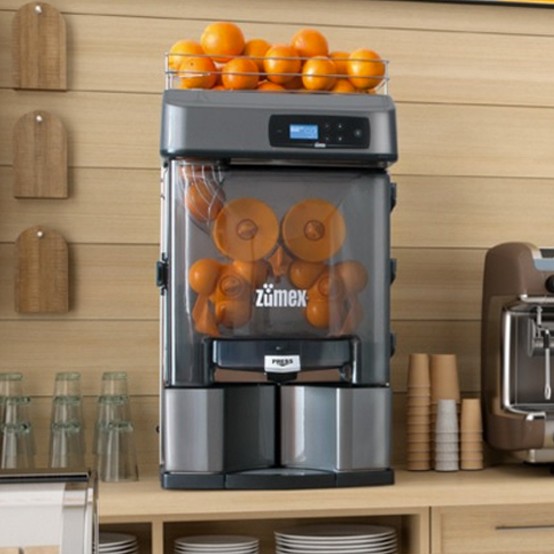
A local grocery store used to make their own fresh squeezed using a refrigerator sized stainless steel machine that might as well have been a Rube Goldberg machine with its winding metal wire chute full of oranges which led to the squeezing head. That thing was kept right in the aisle next to the refrigerator case they kept the juice in. It was the best orange juice though expensive as it was over 10 bucks a quart when the store finally closed. I tried to call and buy the machine but got nowhere. Turns out the owner died so the family closed up the shop and liquidated it.
As for Minute Maid, it has always tasted awful to me and it tasted worse in the 80s. The only packaged OJ I can stand is Tropicana.
Or you can buy a citrus juicer and make it yourself. A couple or three oranges and a few seconds in the morning.
OXO Good Grips runs about $20, it's a squeeze-by-hand option. You can get a wooden reamer, or spend about or upwards of a Franklin for something complicated, though I find simpler is saner.
I have both an old school glass dish reamer as well as a wooden reamer. Use it for making lemon/lime iced tea (using actual tea, not that powered sugar crap) for the summer months.
pretty much everywhere in the Netherlands has contraptions like this, small though, not fridge sized. Didn't see orange concentrate anywhere.
Minute maid actually tastes better than Tropicana to me (can't stand that brand), been getting one from Spain lately at Costco (Don Simon) that's pretty good, less sweet.
I have never liked Tropicana or Minute Maid, but about... 30 years ago? We used to have a brand called Fruvita that actually tasted good but it got bought by Tropicana, the taste changed, and we just stopped buying orange juice.
A Sam's Club in my area has started selling fresh squeezed orange juice. It's quite delicious. (And yes, it's pricey.) I've looked around at many other stores (including places like Whole Foods) and nobody else seems to be doing this.
It’s the boiling frog problem. Consumers gradually become used to lower quality. 15 years ago, McDonald’s was good. You knew it was bad for you but it was so good that you just didn’t care and it was a great cheat meal. You could get an Angus Delux meal for $7. https://wealthgang.com/mcdonalds-prices-throughout-the-years...
Of course they discontinued the angus burgers that actually used high quality ingredients compared to the McDouble / quarter pounders.
Now it’s $12 for a double quarter pounder meal and it tastes like shit. I only notice this because I just didn’t eat there much in the last 15 years. Meat quality and bun quality has clearly gotten worse. I don’t know how they keep growing sales.


A single site consuming more than the entire electrical output of a nuclear core, considering the sheer size and scale of that reactor and its supporting infrastructure and workforce, is just boggling to my mind. It's literally billions of dollars just to feed that one site, if they're being accurate in their proposal.
reply