Honestly, the fact that all his "demo" screens are filled with porn, on a university page, is almost as interesting (in a sociological sense) as the actual clever image multiplexing hack.
I just hope he's only a student, and not in a position of responsibility. (Not that that necessarily makes it OK, but at least it would reflect less on the institution).
edit: ok, not porn, "objectified female bodies". Because that makes it more appropriate?
The choice of images is backwards, that's the only way to describe it. Lenna as reference image was a suitable choice in the 1970s, when IBM engineers would attend live sex shows on the company's dime, but nowadays she raises eyebrows, and we are stuck with her.
The imagery is a statement, and it makes you ask yourself how the place is run. How would someone who isn't exactly like the rest of them fare, someone who is older, female, gay, or not a foosball-playing craft beer fanboy brogrammer? It's a common observation of foreigners that Americans have a very hard time with diversity. A walk around any college campus confirms this. Where are the punks, hippies, and queers? And what's with all the girls wearing hotpants? It's as if they were some kind of uniform.
First, that's not porn. In the worst case, it's "glamour models" (could also be regular models).
Second, we "objectify mens/females bodies" all the time. It just means that we treat them as something nice to look at. That's 90% of Hollywood, pop music, advertisements, and tons of everyday interactions. An art nude, by Picasso or whoever, it's exactly that too.
This guy is not involved in sex trafficking or anything. He just likes how professional models, people paid to be photographed and wishing for a successful career in modeling photography, look on photographs.
Also, from my experience with similar discussions: if he had gay models on the monitors, nobody that speaks of "objectification" would have said anything. Some (stupid) people might have made fun of him for the gay pictures, but champions of non-objectification would not have mentioned anything about objectification.
I don't see any porn there. They may be images of models that participate in adult-themed photo shoots, but none of those images are 'porn'.
It's also not uncommon for images of women from magazines such as Playboy to be used in graphics research. One of the most famous images in computer graphics, 'henna', is a scan from a Playboy magazine.
Porn is a slang term and the definition can be fuzzy depending on context. I don't think it's very common. Lenna is the only on I can think of, and it's more of historical accident.
It's inappropriate because the field of engineering is in dire need of more women, and it doesn't help the situation. Imagine if you wanted to go into a field such as nursing and all of the men in the text books were oiled up shirtless muscular dudes.
>It's inappropriate because the field of engineering is in dire need of more women, and it doesn't help the situation.
That's marketing thinking though, not a real moral objection.
>Imagine if you wanted to go into a field such as nursing and all of the men in the text books were oiled up shirtless muscular dudes.
This is not text books though. It's a student page. If another student, a woman, has pictures of shirtless ripped-abs male actors in her page, I wouldn't bat an eye.
It's rather tacky, sure, but the technical content is good.
Would you prefer he used "objectified male bodies"? "objectified trans bodies"? Guro (don't look this up)? Scat? Cat macros?
Also, how does being in a position of responsibility somehow magically disallow you from expressing yourself honestly (and having to deal with those repercussions)?
Close-minded lot.
EDIT:
I would've used different source images had I been presenting in public, but this looks more like a little project page of some hobby stuff for him. The fact that he decides to use Asian pinups as his test cases is just a minor side-note to me.
>Would you prefer he used "objectified male bodies"? "objectified trans bodies"?
I'm sure the OP is level headed enough to not prefer the author have used any image that objectified a human being, regardless of their sex or gender.
> Also, how does being in a position of responsibility somehow magically disallow you from expressing yourself honestly?
I agree that the level of imposed responsibility is meaningless, but the problem still remains that women are being objectified and it's a normal and casual part of our culture.
>Close-minded lot.
Unnecessary. This exact jab can just as easily be used to get a rise out of your ilk.
>I'm sure the OP is level headed enough to not prefer the author have used any image that objectified a human being, regardless of their sex or gender.
What makes that "level-headed" instead of "wrong in multiple directions"?
Define "objectification". Those are professional models, that specifically picked that line of work, and want to have a succesful career in it. And wanting to appreciate something not for its whole qualities but for some aspect of them is completely normal. When I watch basketball I only care for that guys athletic qualities, not his personality. When I go to a fast food joint, I only care for the persons ability to serve my order, not his/hers other qualities in general.
Heck, I'd consider a photo of McDonald workers flipping burgers far more objectificated, but since it's not "fashionable" enough topic, nobody bats an eye.
I posit the effects run deeper. The idea when discussing these photos is not so much the effect on the subjects (who did indeed choose the field) but the effect on the onlookers and the resulting effect on the general population of women. I hypothesize that viewers of such content are more expectant that all women are to be viewed as sexual objects.
Admittedly, I do not know the extent of which this idea is true; I'm researching now.
That it is a normal and casual part of our culture suggests that it may not be inherently wrong. There are some other (better!) arguments to be made here, but the but but but objectification one is overplayed and usually rings hollow.
If you'd like to make an argument about objectification, we really ought to broaden it to include things like objectification of programmers (rockstar ninja 90+ hr workerbees), of entrepreneurs (I can get 10x my money back if I invest in this person), or of anything else, really.
How would you go about showing that objectification is inherently a bad thing?
EDIT:
Sexual objectification as a particular subset of objectification would be a good starting point. Do be careful in your word choice, because words and phrases have specific connotations.
EDIT2:
Look, look, downvote away, but the deal is that objectification as an argument is so often used and abused in discussions that, unless you are careful, you end up casting a sort of vague "sexy pictures of people are wrong or undesirable" message out.
A lot of people (unfortunately, not always only the ones that are idiots) will tune out your point if you say "objectification" without supporting rhetoric and reasoning. If you want to claim the high-ground (which is not unreasonable), you have to form your arguments better.
So, instead of downvoting because you disagree, downvote and try to explain why sexual objectification is wrong (if it is indeed wrong), why it isn't (or shouldn't be, or should be) held to the same standard as normal objectification (a useful form of abstraction for doing business with people we all use every day), and/or how using any image of a human being without a lot of humanizing detail isn't also objectification.
Taken to its extreme, you end up with something similar to Islamic aniconism. I'm not sure this is a bad thing mind you, but depending on your arguments you may well arrive at a similar proscription.
They're not porn, people pointing it out aren't whining about nothing. You are misusing a word in a way which completely changes the interpretation. Calling something "porn" generally implies nudity, if not actual sex, or at the very least, revealing lingerie. The pictures appear to be of women in bikinis. At least one of them seems to be posing next to a car as you would find at an auto show.
If someone posted an article with screen shots of actual porn, it would be distracting to the point that you would assume he had psychological problems.
The term you're looking for is "swimsuit models", "pin-up models", or "booth babes".
None of these are the "Lena" image. That image is defensible in an image compression context because it's standardized. It's unfortunate that a cropped photo out of Playboy became the standard for image compression, but someone could agree that it's an unfortunate choice, but continue to use it because it is relatively standard. Similarly, others may find its content distracting and unprofessional and use a different image.
And if you want to make a point and try to move people in the direction of realizing that using scantily clad women as a decorative touch is unacceptable in a professional context, you would do well to not exaggerate this and equate it with porn. By calling this "porn" you lump yourself in with the caricature of straw man feminists equating inappropriate remarks with rape.
And your reason for posting this pedantic diatribe hours after the original post was corrected to "objectified female bodies" is... What? To revel in a pedantic takedown of a straw man?
To be really straightforward with it: your post calls for censorship, both self-censorship and the institutional kind. It is your burden to point out why you think using zhis material in illustrations of a technical claim deserves censorship, and if you overstep the line of what is reasonable, you deserve as much criticism as the person you would want to censor.
To be sure, persons (not bodies) can be objectified ... as a means for attaining power, money, sex, whatever. As one person pointed out, the actual contents of the pictures didn't matter to most HN readers, it could have contained gay-specific material and still have the exact effect ("whoa, splitting into three b/w channels"). Was there any objectification involved in the student using these photos to illustrate this point to us? I guess not. Should we be sad that this guy didn't have any pictures of food or sunny beaches that looked recognizable in black and white? Probably yes, even though calling for public ostracism and censorship would be way over the line.
(The operative part of that reply was "hours after it was amended". Your rant, and 90% of the other replies on this thread, added nothing at all to the conversation besides typical red pill douche-baggery.)
I'm posting a day late into the thread to say that all of your posts on this thread have been very counter-productive, glib, and mean-spirited. Please don't accuse other HN'ers you've never met of being douchebags. You ruin the conversation by doing so. This is not reddit, or 4chan, so please don't treat HN as if it were.
I'm frankly shocked that dang hasn't been here to state this for me.
While I agree it's an interesting choice of demo images and I would have chosen differently, I really don't care. He could have used gay porn and I still wouldn't care.
It's a fun little project, if you're into electronics, but perhaps not all that useful.
Well, I probably would be annoyed/mildly offended if it was truly graphic. E.G. if it was a clip from one of those beheading videos, or hardcore porn, or... Choice of images isn't utterly irrelevant.
It's not politically correct...the author of the comment was acknowledging that the word choice used was incorrect, and amended (not edited!) their comment to show a different phrase.
When discussing things of a delicate nature, where precision matters and thoughtless wordchoice will easily derail any useful discussion, having such scruples is something to celebrate and not mock.
I am glad so many people today are familiar with that particular reference image. Choosing Lenna (or the baboon or the Landsat picture of the Bay Area) simply shows that one knows one's history and one has some respect for the pioneers.
At the end of the day these images are arrangements of ones and zeroes yet so much more than that at the same time. Long live Lenna!
This is a student's account. In the CS department at Northeastern, each student is given some server space and can do almost whatever they want with it, including hosting a website.
In fact, all of his non-technical images are of scantily clad or posing women. That's fine in some contexts, but definitely not professional or welcoming to female students.
> In fact, all of his non-technical images are of scantily clad or posing women. That's fine in some contexts, but definitely not professional or welcoming to female students.
The professionalism of the photos on a university website is an entirely different issue. I was addressing the point of the photos objectifying the women.
There was a convention in my state this past weekend that had plenty of "cosplayers", men and women, who were dressed similarly to the women in these pictures. They were scantily clad as you mentioned. I'm sure many of these people wish they could dress that way on a day to day basis but it's not yet acceptable in today's society so they don't. Hardly anyone would say they were objectifying themselves, so how is this any different without making assumptions about the source of the photos? Maybe these women also choose to dress this way?
I think that objectification is part of the reason that many cosplayers do not dress as they do on a normal basis. We live in a culture of sexual repression, and as a result: sexual objectification.
If muscular men were dramatically underrepresented in STEM careers, and particularly EE, then I would have a problem with that.
If you really want to pursue this line of thinking, what if a female nurse had posted a hobby page wherein she documented all the ways nurses most often contaminate hospitals or traumatize children, and all the "example" nurses in the pictures were male.
But really, that's not a perfect analogy. Female bodies != male bodies in our culture, particularly in STEM careers. It is at best impolite (and at worst creating a hostile work/study environment) to use these images in a page on a university website.
It's interesting that one of the only Ivy programs which is essentially immune to this gaming of the system is Harvard Business School, which allows only one semi-optional free-form essay ("What else would you like us to know?":(http://www.hbs.edu/mba/admissions/application-process/Pages/...) and requires a follow-up letter to every in-person interview.
The irony of course is that the scions of empires and children of privilege who are being groomed for leadership essentially get a free pass at admissions. (Which has a sort of logic when you consider that they form the backbone of the class power network almost immediately upon graduation).
(As an HBS graduate I have mixed feelings about the overall privilege distribution, but admit to having no plausible suggestions of how to address it.)
> It's interesting that one of the only Ivy programs which is essentially immune to this gaming of the system is Harvard Business School
Having known many peers at HBS, I highly doubt the truth of your claim. It seems extremely biased based on your own background. Do you have any evidence?
The happiest moment of my entrepreneurial life was after my second exit, when I realized that I could self-fund/bootstrap my next venture comfortably and never deal with a VC again.
Meddling, conniving & power-drunk busybodies, all of them.
That's a genuinely interesting statement. If you don't mind me asking... how many times have you failed? Two successes is seriously brilliant, and rare, but the idea that what you'd take away from that is a preference to take on all the risk yourself is surprising. One of the key things I believe I've learnt over my entrepreneurial career to date is that it's a hell of a lot better (well, safer) to risk someone else's money.
My conclusion is that for a multitude of reasons (most of which are well known) having involved investors reduces my chances of success considerably. And all they offer is money.
"And all they offer is money." - I think that's part of the problem you experienced. I've worked with some good investors in the past and they offered great mentoring and networks. A serious question would be "Did you go looking at them primarily for the money?"
I've worked as an analyst for a VC ($200M under management, so not huge nor small), and I can honestly say that you could find better advice by perusing the business book section of your local thrift store.
Part of the problem is the number of "dumb luck" one-time entrepreneurs that make it into VC Partner positions, that think they can extrapolate and apply their limited experience to anything under the sun.
Overconfidence in their own wisdom is hugely problematic, and most of them don't know the line between mentorship and being a de-facto CEO. Very rarely do you hear "I ran into a similar problem and this is how we solved it". Most of the time it is "Do it this way, just trust me because I had a $15M exit back in 1998", and occasionally it becomes "Do this or else we'll throw you out."
I had very different experiences, so tend to strongly disagree with the overall premise but not the average VC premise. There's a power law to VC's, as there is to much out here - the really great VC's are worth their weight and then some; the average to mediocre ones can be downright harmful.
Given that VC industry as a whole doesn't outperform major stock indices, it stands to reason that an average VC doesn't have that much wisdom to offer. Nevertheless, they offer financing and potential networks that you can mine.
Opposite for me. I wish I took VC money. I bootstrapped my startup. We failed. And part of why we failed (besides obviously being cash strapped) was the early validation that we were lacking (from a customer side, but also from an investor/VC side). One shouldn't underestimate the experience and connections those guys have.
> And part of why we failed (besides obviously being cash strapped) was the early validation that we were lacking (from a customer side, but also from an investor/VC side).
If you lack customer validation, you don't have a business. Period. Beyond the seed stage, venture firms are investing to scale nascent businesses. Without customer validation, you aren't going to be able to raise a meaningful amount of capital from investors. Put simply, investor validation is a function of customer validation.
The great thing about customer validation is that you don't need lots of money to get in front of customers, and sometimes you don't even need a finished product at all. No VC is going to do this legwork for you.
I don't understand this. If you turned down VC money ("I wish I took VC money") then what do you mean by "early validation that we were lacking ... from an investor/VC side?"
Do you mean that you weren't able to be taken seriously because you didn't have VC behind you? Or do you mean that you wish you had the opportunity to take VC money?
If the former, I'd like to hear more about it if you can share.
I think they're all clean-shaven and with short hair too. Some anomalies may exist, but I wonder if the ones that look different get walled off -- and with it their personalities and progression.
In the first post Redis + asynchronous replication + (an alpha version of) Sentinel were found to lose writes during partitions. This is an obvious result of asynchronous replication + failover, since this is, technically, an eventually consistent system where the merge function is picking a single timeline when there are divergences. Redis was improved since then by adding heuristics to practically lose less writes, but basically this was an expected result that nobody can change.
In the second blog post I proposed, just for an argument of a different discussion, a strongly consistent system where basically you have God coordinating the failover, and every write replicated N times. This is something that's not even worth to test, since it is obvious that a system like that is linearizable, however it was still tested, and since it was obviously flawless per definition, the flaw was found, very surprising, in something that violates any CP system, that is, serving reads directly without any agreement. Later Aphyr in this article (http://aphyr.com/posts/316-call-me-maybe-etcd-and-consul) pointed to reading from a possible stale leader as a flaw, while in its implementation in the previous article he setup the things in order to explicitly read from nodes directly.
In both the instances I can't see how this translates to me not understanding stuff. That said, distributed systems are all about details, and while I'll try hard to do my best, I can still end with something buggy. I try to improve my knowledge every day and I understand I'm not an expert in the field and that I need to learn, test my designs, make them publish in the hope that other people will analyze them, and so forth. However I believe I'm not the only one that needs to perform this learning process, especially if you want to point at random articles on the web as evidence of my failure, you also need to have a solid understanding of the basic principles.
You're assuming that the factors which drive women out of engineering do so independent of ability.
I would hypothesize that this is false, that the most interested and passionate women are least likely to be nudged out. Google should be comparing its ratio to that of their potential pool, which is presumably skewed high. If that's true, they should be expecting to get closer to 50%. (Not exactly 50, but better than the holistic ratio at least.).
Also, they can look at their specific source pools to get a less hypothetical target. Berkeley is ~50/50, for example. (http://www.wired.com/2014/02/berkeley-women/). But retroactively
And if women are less interested overall in CS and/or have less ability on non-verbal tasks overall then you would expect that the RHS tail of the distribution of women would be lower than the RHS tail of the distribution of men. This is just basic statistics.
The same applies with African Americans. Blacks in the US have far lower IQs than whites - this is not in dispute though there is a certain amount of dispute about the reason, with some people attributing it to environment. As such the normal distribution will ensure that a much lower percentage of blacks will be at the high end of the scale (135IQ+) where google gets their recruits.
So the fact that google is close to the averages suggests they are already making a lot of effort to bring in women (and non-asian) minorities. Asians are highly over-represented at google versus their fraction of the population.
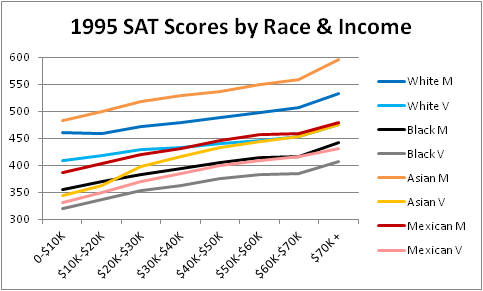
I see a lot of people make claims like this, or even stronger ones such as claiming it has little/nothing to do with environment. Charts like this bear that out somewhat with the poorest Asian and white students scoring higher on the SATs than well to do blacks: http://1.bp.blogspot.com/-1a52vkpjans/UmjAc5fGxtI/AAAAAAAAA6...
Generally, people I see who bring this up are usually using it as a thin veneer over racist beliefs. When asked what end discussing minority IQ serves, they usually suggest defunding inner-city (read: black) schools or similar measures.
I can't get on board with that. I think the US certainly fails at providing equality of opportunity to many groups, and there is still widespread discrimination against women and minorities. We can certainly do better and we should view people individually rather than treating them in a prejudiced way based on group membership.
I also have a hard time getting on board with a "blank slate" view of humanity. I'd love for someone to prove me wrong so I could fire back at "race realist" reddit commenters, but it seems plausible to me that different groups, especially men and women, are biologically predisposed to certain traits, on average.
I know in my career that requires both a certain amount of aggressiveness and quantitative aptitude that my colleagues have overwhelmingly been Asian or white men. I've worked with women and "under-represented minorities" who've made me feel like a chump trading, and I certainly don't harbor prejudices about them, but they're difficult to find.
As such the normal distribution will ensure that a much lower percentage of blacks will be at the high end of the scale (135IQ+) where google gets their recruits.
There's little evidence that IQ and programming ability are correlated.
There is some evidence[1] that Mathematical ability and success at programming are correlated (30%). [1] shows that gender and programming success are correlated, but others show no correlation at all.
[1] shows an 8% correlation between spatial ability and success at programming are correlated, while [2] showed "only a small correlation".
[2] shows that people who are successful at program articulate tasks differently to those who are not.
> There's little evidence that IQ and programming ability are correlated.
Yes, but while programming ability is no doubt a priority for Google in programming positions, its not unlikely that general intelligence is something they desire in a broad array of positions (including programming positions.)
So, its not entirely implausible that, to the extent that there are group differences in IQ distribution, those play some role in explaining Google's diversity results (of course, IQ is not purely innate and does appear to be influenced by a number of environmental factors, though those are even farther upstream from hiring than the kind of things that Google is focussing on with regard to educational opportunities in computing for women and minorities. But there is no reason Google couldn't work to improve those, too.
I can verify that, when inebriated, I am a terrible judge of character, and trust many people I shouldn't (even when my friends try to warn me off)... The number of times I've gone out questing while drunk and ended up in the company of some loser (while wearing sub-optimal gear) is uncomfortably high. The next morning my memory is almost always corrupted. Only by sheer luck have I not yet been fragged in a PvP area (and having rolled female this life, I wouldn't have much chance of defending myself.)
I'd love to see a comparison among the same sample set between Java8 & Scala as the next environment they're likely to use.
Scala has been "the next big thing" for a while now, but I'm just not convinced that the Java ecosystem is looking for a next thing at all.
To be clear: I absolutely agree that we can do better than Java, and though I prefer Clojure, Scala is certainly a step up. I'm just not convinced that the practical realities of its user base are enough to drive that change, which limits my willingness to move my organization in that direction.
It doesn't make it true either, and nothing that the original poster said suggested that it might be the case. Heck, we don't even know the gender of the original poster.
The core idea of the book (the OASIS) is great, and a lot of fun to think about. The actual story gets absurdly bogged down in 80s pop culture references. Even for people who enjoy all that stuff, it seems like a bit much.
I'd still recommend the book too, as a fun read. I just hope there's a sequel that's completely detached from the 80s.
At the risk of sounding overly negative, I think RPO gets a lot of praise that it really doesn't deserve. The concept of the OASIS is neat, and the segments dealing with the nature of VR in society (education in VR, logging in to escape the reality of life in the "stacks", the lengths to which the main character goes when dedicating his life and daily habits entirely toward the Quest). But it's all wrapped up in a bunch of shallow 80's references that made me feel like the author was insecure about the strength of his own ideas and needed a bunch of Family-Guy-esque name-dropping so the nerd demographic reading it could say "Oh, I know that reference!" When I read a book taking place in the future, I sort of hope that there's something there about the future to explore rather than getting the sense that all culture and media just stopped in the end of the 20th century and the only thing that happened since was VR getting developed. Strikes me as reader/author wish fulfillment.
The protagonists weren't likable, the villainous evil corporate anti-open-source drones were stunningly one-dimensional, the two Japanese brother characters felt like walking MY SAMURAI HONOR stereotypes, and the romance with Art3mis felt like getting the princess at the end of a game as a prize (which would be a neat parallel with the video game references were it not played straight). If I was younger when reading it I would have been more forgiving, but it all felt like a "kids rule, grown-ups drool" sort of plot.
It seems like, despite the protagonist's fears about IOI turning the OASIS into a soul-less amusement park, that's kind of what the OASIS already was in the story. There wasn't much talk about players generating new worlds and new experiences -- most of the time characters were enjoying the pre-packaged "Lord of the Rings", "Star Trek", or "Dungeons and Dragons" VR worlds, reliving existing ideas again and again. The gunter protagonists weren't off creating fantastic new landscapes or generating culture, they were poring through the ruins of the old trying to find some arcane clue -- and I didn't get the sense that they would be doing that if they didn't have the Hunt to focus on.
These are interesting things to think about -- and definitely a worrisome part of dystopian visions of VR that turn the ultimate communication/creation tool into a trough full of pre-packaged feed for consumers -- but I don't think that RPO's author was attempting to focus on that. Rather, the sterile emptiness I felt from the OASIS seemed more a result of the author just not describing much that wasn't necessarily "just so" for the plot.
There are a lot of neat VR ideas in it that I hope get more exposure, but it's despite the nature of the book rather than because of it.
I don't disagree with your assessment of the book and its ideas. The book is not very deep on any level, technical or emotional.
For me, it doesn't have to be. It's a light, fun read that I can scramble through and smile about when I need an escape from my own reality.
That's not to say there aren't some solid ideas that should be explored in greater depth. I just don't think this particular story is the right place to dig deep.
Someone in this thread suggested that they might enjoy a sequel. I partially agree ... I think that the technology ideas, the dystopian future, and the OASIS itself lend themselves greatly to deeper exploration as a setting. I just don't really think most of the characters are worth exploring any deeper. The story is good, maybe even great (I like it a lot, but I'm weird), but it feels complete. Let's move on and play a little with the RPO fictional world itself.
As we move intelligence to the client, we're starting to use a lot of data queries which were never meant for the wire. (Particularly in IT applications.)
Having a way to filter in those cases would save having to write & maintain a whole new CRUD layer. In the long run, it could even lead to more efficient queries when objects are composed of many records.


I just hope he's only a student, and not in a position of responsibility. (Not that that necessarily makes it OK, but at least it would reflect less on the institution).
edit: ok, not porn, "objectified female bodies". Because that makes it more appropriate?