For my master thesis I did a lot of digging into the research on success factors for startups. And at least based on what I found back then, you're right. The correlation is weak between any factor like this and success. Generally positive though, so it does make sense to try doing some planning. But it's definitely not a requirement.
In general, observable factors doesn't strongly correlate with success. Probably both because there are so many to choose from and because the real world is complex and typically doesn't align well with any predefined plan.
This kind of analysis sounds far more interesting than a lot of the "just do what I did!" startup writing that's out there. Do you have any recommendations for further reading from this perspective?
Feature request: Make it default behavior on phones that you can have multiple passwords, connected to different profiles. With no way to determine how many profiles a phone have.
I'm sure there's some people here working on mobile operating systems, might be worth considering?
"This profile doesn't have anything on it. Give us the password for the real profile."
Or even worse, you did give them the real password, but because your phone supports the feature and your profile is kind of barren, they don't believe you. Now you are in a very bad lose-lose situation.
You do use your "fake" profile regularly, just for "sanitized" activities. Check in on official sanctioned news sources, do your "legit" banking and financial stuff, etc.
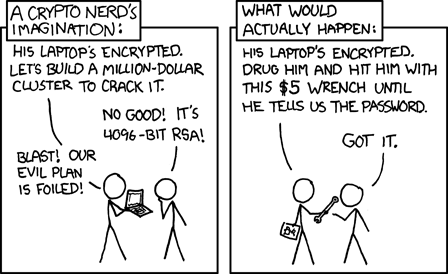
Software isn't going to save you in this scenario. If you're worried about local laws violating your privacy then buy a burner and only put data on there that's necessary for your travels.
Allow the device user to create a different (duress) password, which when entered, will immediately wipe the phone without any secondary warnings. The user could then provide that password to the people who seized their device, and be in compliance with all laws, while maintaining information security.
As others have pointed out this would likely not save you in this case, but there are some phones which do support this, and I know people in Brazil that use these features in order to be able to comply when getting mugged without giving away access to your bank etc.
Android has a "Private Space" feature. As far as I can tell it's only a single extra profile you can create, but I think you can keep it "hidden" (at least in as much as you can't tell if it's been created without unlocking it).
This whole PRC law (system) is designed to condemn already targeted individuals, there's no big difference if there's nothing on the phone. Chinese laws are specifically formulated in this pattern: "A, B, C, or at the discretion of the relevant authorities". Since there's no attorney-client privilege in PRC, once you're targeted, the "discretion" can always be found.
Crypto wallets work like that. Put in a different password (in addition to the seed) and it's a different account, preferably with some chump change on it for plausibility.
Didn't it start with asm.js, a subset of javascript serving as a way to compile C code to be run in a browser? Then browser makers figured that it'd be better to have a dedicated target for this. So while it can be used to achieve performance in specific scenarions, it's largely designed with the goal in mind to be able to run non js code in a browser. The wasm toolchain Emscripten encompasses this notion quite clearly as it emulates things like filesystems etc. If the main goal was faster execution, they would probably have gone a different route. PRobably even gone for a new language altogether.
I'd like a toolchain better targeted for the pure acceleration use case though. Emscripten adds a lot of bloat and edges just to serve out of the box posix compatibility. Which is nice for quick demos of "look I can run Doom in the browser"-kind. But less useful for advanced web app usage, where you anyways will want to keep control of such behavior and interact with the browser apis more directly.
It started even much earlier. At first Emscripten compiled to a plain Javascript subset, after this demonstrated 'usefulness' this JS subset was properly specificed into 'asm.js' which browsers could specifically target and optimize for. The next evolutionary step was WASM (which didn't immediately bring any peformance improvements over asm.js, but allowed further improvements without having to 'compromise' Javascript with features that are only useful for a compilation target).
It's the difference between proportional voting vs winner takes it all. In the latter case you can't really hold politicians accountable, as you will have to choose between effectively throwing your vote away or voting for the one opposition candidate, that often will be just as bad.
While the UK have some level of representativeness, each circuit has a winner takes it all structure, making change quite hard to achieve on a larger scale.
This might be a "grass is greener" thing. Do elected representatives actually have higher approval rating, or enact policies that better fit with public opinion, under proportional systems? Sure it'd probably make things a little better, but it won't actually solve anything hard, I think. All Western countries are struggling (and mostly failing) to deal with the same problems regardless of details like electoral system.
With proportionate representation you get what _should_ happen, in my opinion, which is sometimes nothing. If the coalition can't decide on something, then it doesn't happen, which is the correct outcome because not enough people agree about it. It represents the people (who also can not agree on it).
The alternative is a decision that most people don't agree with.
That sounds like kind of a mirror of some of peoples biggest complaints regarding bureaucracy and committees. Deadlock can not only be worse than an imperfect solution, it can be weaponized by a minority to exert outsized power and extract otherwise unthinkable concessions. We see this sometimes in the US House, where more fringe or radical groups within parties can block the literally functioning of the actual country, safe in their assumptions that the two parties will not form a majority coalition and that the parties as a whole will take more damage from the fallout than the radical groups.
I'm not saying that that makes the system worse, mind you. I'm not even saying you're wrong that it's a better system. I just think anyone who thinks any one system is the easy, obvious fix to fair and just representational government is either shortsighted, or has different priorities than I do.
That's ironically just something the British government used to pride themselves on, Pragmatism.
If it's important enough or dysfunctional enough a quick decision will be taken. There's clearly deadlock in first past post too, look at the US, if neither party advocates for it at all, it gets nowhere.
My view is it's always organised elites making the decisions, no matter the system. Nominally left-wing parties often make brazen right-wing moves, and vice-versa. The votes that matter are those of the MPs, Congress members etc. which are always influenced by a range of factors and organised factions. That's the actual decision-making mechanism.
It’s the organized elites, true, but they aren’t a monolithic block either. In a proportional system they also must spread their influence on many parties. This is a good thing. With a single party there is a greater risk of a cordyceps infection taking over, see Republicans.
IMHO the simple change that would have the biggest effect on the American political system would be to require Congresspeople to live full-time in their districts and conduct all official business over videoconference and e-mail. Lots of behavioral science has shown that the biggest generator of trust and allegiance is physical proximity and face-to-face interactions. Make all reps have their face to face interactions with their constituents and maybe they will actually start representing their constituents. It also makes lobbying a lot less economical (instead of hiring one lobbyist that can have lunch with 435 representatives, you would need 435 lobbyists, or at least 435 plane trips) and gerrymandering a bit less practical (there's a decent chance the rep would no longer live in the district and be forced to give up their seat).
That and ensuring a bidirectional feedback mechanism between the executive and legislative branch, so that laws that aren't enforced by an administration fall off the books, and presidents that don't enforce the laws lose their job. Right now, the legal corpus of the U.S. is a constantly-accreting body, which means that no matter what the President wants to do, they can find some law somewhere to justify it, and then anything they don't want to do, they just say "We don't have the resources to enforce this". This gives the President all the power. They should be a servant to the law, not its arbiter.
It's the opposite of what you say. Proportional representation isn't accountable because you don't know what coalition you're voting for - coalitions are done in backrooms after the election. Winner takes all is more accountable because the coalitions are done before the election (aka political parties). Parties are made up of different factions and they're agreed before the election.
I guess you don't live in the UK, because winner takes all is far worse for backroom deals. The deals just end up being between factions within the same party!
Deals and bargaining all happen AFTER a party takes power and completely hidden until a government can't pass their own bills like the Labour attempt to reform welfare.
With proportional representation the deals are made in order to form a government, BEFORE it has power, and are between separate political parties.
Sure there may be agreements that are not all made public, but these are much harder to keep in the "backroom".
This time everyone voted for Starmer and got friend-of-Epstein Mandelson via McSweeney as a cut-out.
PMs don't drive the agenda. The UK is one of the most corrupt developed countries in the world. The people driving the agenda are billionaire and multi-millionaire donors.
PM is a sales job, not a strategy job, and increasingly ridiculous PMs have been selected because the donors have had enough of liberal democracy as a concept. If it stops working - which it pretty much has - there's going to be less resistance to removing it altogether.
Which is why there's resistance to Digital ID. There's widespread distrust - with reason - of the political establishment right across the divide.
I think he's right, actually. It rings true with what we see here in the Netherlands. People don't feel like they're "throwing their vote away" if they vote for a minor party, so politicians can't have a laid back attitude.
There are efforts to make this happen in the us starting locally and working up. The states are left to decide how they implement elections on their own with a couple of exceptions. There is a tragedy of the commons aspect to it though, as if some states adopt proportional representation but not others the ones that do not adopt it gain advantage. Ranked choice voting is taking hold much faster than pr in the us, and it is pretty slow too. It can happen though. Both are viewed as being left leaning, which doesn't really make sense to me.
If their minor party doesn't end up as part of the governing coalition, there's no sense in which people feel like their vote wound up having no effect?
That's not really true. It just means there is a gradient of success rather than outright success or loss. Particular portions of what you voted for may be successful.
First past the post means you take it all or leave it all, policywise, small things are likely to fall through the cracks.
Don't vote. By voting, you partake in a system unable to give most people effective representation. By voting, you ostensibly accept your own alienation.
This is bad advice. By voting, you accept nothing. By not voting, you merely lose the small power that voting grants you. (Why do you think people are working so hard to disenfranchise voters in the US?)
Construct better systems, by all means, but don't just ignore the system that exists.
Maybe he's actually wearing protective gear? Jeans with slide tolerant layers and padding are pretty common as warm weather gear and there are jeans style jackets as well. If you don't know what to look for it can be hard to tell the difference to regular clothing.
* Have a license
* Wear appropriate gear
* Follow speed limits
* Don't drink and ride
* Aged somewhere 30-50
* Have more than a few months experience on your bike
* etc.
You are statistically "one of the safer ones". Not safe, you are never truly safe when in traffic.
On the rare occasion I watch YouTube via my Roku stick, ads cause me to mute the tv and skip when I can. I guess I could put a mini pc behind the TV and get all the browser extensions but this compromise is good enough for my lazy self.
It takes away the ability to know what it does though, which is also often considered an important aspect. By not publishing details on how to train the model, there's no way to know if they have included intentional misbehavior in the training. If they'd provide everything needed to train your own model, you could ensure that it's not by choosing your own data using the same methodology.
IMO it should be considered freeware, and only partially open. It's like releasing an open source program with a part of it delivered as a binary.


In general, observable factors doesn't strongly correlate with success. Probably both because there are so many to choose from and because the real world is complex and typically doesn't align well with any predefined plan.