>Lots of them were banished from the island by Russian Empire.
You either use this as a very politically loaded term for Stalinist Soviet Union (which is a problem with your post on its own right), or you are wrong.
>- But russians usually don't remember Dagestan(Russia) or the Chechen Republic(Russia) where the number of russians is less than 5%. Or Belgium with german speaking people .
Russia and Belgium, unlike Ukraine, aren't nation states. Russia is a multi-ethnic country, which is stated in its constitution.
> Ukrainian regions were a part of the Russian Empire for quite a long time. Why would they not join Russia?
Why should they?
>- Crimea is an autonomy, but even now russians stimulated by pro-Russia politicians say that they want Ukraine to be a federation. Do they know what is the difference between autonomy and federation?
So some Russians say one thing, other Russians say different things, so what? I tell you that there is a great deal of difference between unitary state with some autonomies and federation (which is obvious really, think Spain and USA).
>If you look at the Russian Imperial Census of 1897 you will see that people living in the eastern part of modern Ukraine were 80-90% ukrainian speaking. And now if you go to the country area of eastern regions you will see lots of ukrainian speaking people.
How is the census of 1897 related? You wouldn't say parts of Far East and Siberia, which were predominantly Ukrainian-speaking then should be parts of Ukraine now?
>There were 3 man-made famine in Ukrainian SSR conducted by Soviet regime and lots of repressions killed more ukrainians than ukrainians died during the 2 World War.
Oh, now 3 man-made famines specifically designed to destroy Ukrainian nation, great. What do you think of people of Lower Volga, North Caucasus and Siberia who perished of famine of 1932-1933? I guess you prefer not to notice their existence because they don't serve your political goals of the day.
>And now guess what Stalin does? He invites russians to the industrial western part of Ukraine. This region required a work force at that time.
Yeah, I guess it's also Stalin (a Georgian btw) who put all the iron ore and coal there, just to extinguish all the Ukrainians so when Ukraine becomes independent there are less Ukrainian-speaking people there? What a prophet, wasn't he? Or should he just ignore industrial potential of Eastern Ukraine whatsoever?
This is a really telling example of Russia-directed scare-mongering, I feel uneasy about it, as a Russian.
>starts to eat more money for social subsidies than it produces
>Crimea has been always unprofitable even with its lucrative tourism industry
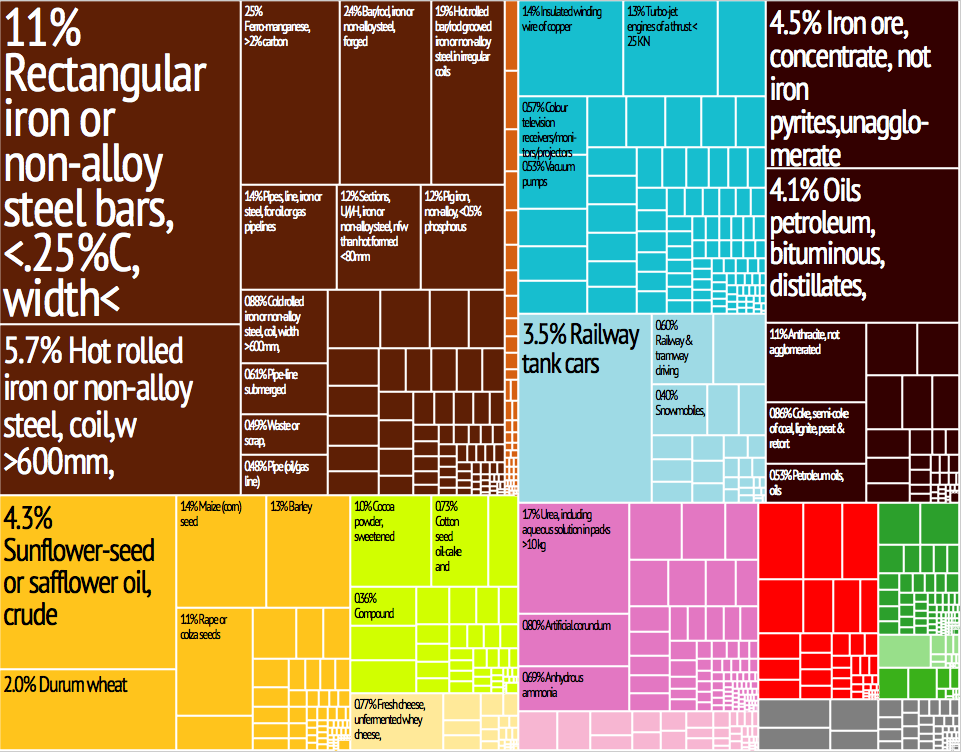
Not a marker of anything, there are only a few oblasts in Ukraine that are profitable (taxes - government spending), until very recently none of them were in the Western part of the country. This may be not the best way to judge contribution of different parts of the country into the economy. If you give a look at exports structure (http://upload.wikimedia.org/wikipedia/commons/1/13/Ukraine_E...), you can clearly see that it is dominated by products of exclusively Eastern industries.
Do you guys consider federalisation as an option? Ukraine seems like a sufficiently big and diverse country for that.
It sure as hell won't resolve the problem of which trade block to join though.
That's pretty interesting and bears some ramifications. Like the fact that Americans might have been not a smiling bunch before dentistry became widely accessible (this might have happened not too long ago). Or that before advent of cariogenic foodstuffs (eg in Middle Ages and antiquity) people tended to smile more. I wonder if it is any true.
You mean people in America don't feel this way about street preachers? Even the kind that walks around with a sign and shouts REPENT! and all?
> I could give a $100 bill to a cashier at the grocery store without getting in trouble.
You mean you literally handed her a 100 dollar bill? That's not her fault, you should exchange your money. Imagine someone trying to pay with hrivnas in 7-11.
So somehow before 1930s people trusted one another better? I believe it seriously lacks evidence. What about people in Western Europe who don't smile all that much really?
Is this some knee-jerk reaction or something? Russia-gulag and all? For a foreigner it is permissible, not so much for a Russian. I think we need to overgrow this if nice things are to be had.
What changed in the 1930s? In Russia if you wanted to keep your head, you kept your head down in 1917, you kept your head down in 1905, and you kept your head down in 1800's and earlier - deportation to Siberia for being unpleasant to ruling class was a thing for centuries before Russia became Soviet.
That's so very simplistic though. You by no means kept your head low in 1905, and 1917 since those were years of revolutions, the later two pretty successful, which brought freedoms unmatched in that time. In what other army was an order compared to Order #1 of 1917 in act? What other nation decriminalized homosexuality in 1917? There were select few to allow women to vote as early as 1917 and none at all to admit women to general workforce as equals. In what other nation had organs directly elected by workers and soldiers (eg peasants) ruled the country at least for one day? Of course it was all very short-lived (not without involvement of armies of certain 'freedom loving' nations), but this one event so utterly debunks this theory of 'keeping your head low'. And even then, 'in 1800's and earlier' were very different times, when people 'kept their head low' pretty much anywhere in the world.
How many unrelated people were executed or imprisoned during and right after 1917 and 1905? How many of the revolutionaries were 'removed' by their own for sticking out?
During the civil war and afterwards, how much the fate and life of common people depended on the whim and 'perception of loyalty to X' ? In order to prosper (or even survive) your allegiance would have to be flexible enough to adapt quickly, or you'd get eliminated. As the saying goes, 'the tall poppies get cut first' - no matter if you were for or against the revolution.
1917 was a result of picking a fight with authority, but the aftermath of 1917 was to eliminate anyone else who'd pick a fight with authority - both outside and within the revolution.
This is what I mean by 'keep your head down'. There's a curse "may you live in interesting times". Living in such times teaches you and the whole society to be mindful about what you say, careful if your beliefs are perceived as proper, and not to pick a fight with authority.
Probably no unrelated people at all were executed or imprisoned in 1917 or 1905. Even for the most frantic career revolutionaries it wasn't uncommon to flee from the deportation and live illegally in Russia or to emigrate.
I don't think what you are describing is in any way specific to Russian Revolution and Civil War. If reasoning like that is justified, you can 'prove' the same thing about any society that lived through a social calamity.
"Probably no unrelated people at all were executed or imprisoned in 1917 or 1905" -- are you serious? Really?
There were bloody purges after 1905 enforcing 'summary punishment' against, say, everyone living in a specific village, in order to make a warning for others. My local area lists 500 official executions of revolutionaries, but 2000+ 'collateral deaths' happened in the process.
1917 was followed by (1) a civil war, (2) class warfare - reprisals against millions of people where the fact if you were killed or deported was determined in part by wealth, but in part by your connections and local denouncements. (3) internal conflicts such as Tambov rebellion which also meant that you can easily lose everything for something your neighbor did.
Most societies that lived through a social calamity did not endure long periods of internal treachery affecting not a small prosecuted minority but huge parts of population - well, Pol Pot and China Cultural Revolution did, but I'd argue that they had similar effects on their societies.
What does it mean to be a Russian-American? He left the country when he was 5? He was born in US to Russian parents? His comment is pretty ignorant. The article is fairly accurate.
I am talking about people who immigrated as adults. The way he talks about his experience in Russia cues that he belongs to that group. His post may be too harsh, but it is certainly not in the same league with truly ignorant knee-jerk comments about gulag.


You either use this as a very politically loaded term for Stalinist Soviet Union (which is a problem with your post on its own right), or you are wrong.
>- But russians usually don't remember Dagestan(Russia) or the Chechen Republic(Russia) where the number of russians is less than 5%. Or Belgium with german speaking people .
Russia and Belgium, unlike Ukraine, aren't nation states. Russia is a multi-ethnic country, which is stated in its constitution.
> Ukrainian regions were a part of the Russian Empire for quite a long time. Why would they not join Russia?
Why should they?
>- Crimea is an autonomy, but even now russians stimulated by pro-Russia politicians say that they want Ukraine to be a federation. Do they know what is the difference between autonomy and federation?
So some Russians say one thing, other Russians say different things, so what? I tell you that there is a great deal of difference between unitary state with some autonomies and federation (which is obvious really, think Spain and USA).
>If you look at the Russian Imperial Census of 1897 you will see that people living in the eastern part of modern Ukraine were 80-90% ukrainian speaking. And now if you go to the country area of eastern regions you will see lots of ukrainian speaking people.
How is the census of 1897 related? You wouldn't say parts of Far East and Siberia, which were predominantly Ukrainian-speaking then should be parts of Ukraine now?
>There were 3 man-made famine in Ukrainian SSR conducted by Soviet regime and lots of repressions killed more ukrainians than ukrainians died during the 2 World War.
Oh, now 3 man-made famines specifically designed to destroy Ukrainian nation, great. What do you think of people of Lower Volga, North Caucasus and Siberia who perished of famine of 1932-1933? I guess you prefer not to notice their existence because they don't serve your political goals of the day.
>And now guess what Stalin does? He invites russians to the industrial western part of Ukraine. This region required a work force at that time.
Yeah, I guess it's also Stalin (a Georgian btw) who put all the iron ore and coal there, just to extinguish all the Ukrainians so when Ukraine becomes independent there are less Ukrainian-speaking people there? What a prophet, wasn't he? Or should he just ignore industrial potential of Eastern Ukraine whatsoever?
This is a really telling example of Russia-directed scare-mongering, I feel uneasy about it, as a Russian.