Good luck getting other countries to "play along". Doing this is tantamount to handicapping your nation's corporate giants, who will no longer be able to compete as effectively against the corporate giants of nations that don't play along.
This line of thinking is how you end up like Europe that today consumes goods and services produced almost entirely by large US tech companies. If you handicap the American tech giants this way, prepare for a world where the only remaining tech giants dominating globally are Chinese, Korean and Japanese (it wouldn't be Europe because Europe has already handicapped its businesses).
I'm honestly amazed that most people that don't realize that your country's businesses are in competition with all the businesses of other countries. A well meaning policy that would be good for your nation pre-globalization will handicap and disadvantage your country's economy now that globalization is the status quo.
Economic nationalism is a prerequisite if you want to live in an economically prosperous nation.
Obviously you would need to have a blanket ban on overly large corporations operating in your country and on goods and services produced by overly large corporations being imported into your country. You couldn't apply it only to domestic corporations.
Genuinely curious as to why you say Europe has handicapped its business? They are just more regulated. If the businesses are handicapped why is Germany still a giant in manufacturing?
To answer your question, the reason Germany does best is because they are in the EU. Under the Deutschmark, increased exports would have increased the value of their currency and hurt exports. With the Euro, they generously benefit from the fact that they can export to the entirety of Europe without experiencing currency appreciation and the current account weakness of other European states means that the value of the Euro is kept lower than the Deutschmark would be, meaning that Germany gets an added export advantage in international trade.
How many new major European multi-nationals have been created since the creation of the EU?
There was a video on building monopolies the other day[1] which pointed out that tech companies' "other bets" are designed to make them look less monopolistic. Google can say "we're not a monopoly in phone software or self-driving cars" and divert attention from being a near-monopoly in search engines and advertising.
I think it's possibly a bit soon to go down this route. There needs to be more time to determine whether these new companies are in fact monopolies and if that has a bad effect on competition. If no tech companies of a similar scale appeared in the next ten or fifteen years, and if the company rankings remain largely unchanged, I would probably revisit that position.
Why would we consider google a monopoly before cell-providers, ISPs, major credit card companies, or auto companies? [All of whom actively have stifled competition in unfair ways]
You can make the point that even in a market economy, the internal economy of a company is communist: it is centrally controlled/planned and not market base. Outside, big companies can distort the market because of they weight and there ability to use international difference (price transfer, little effective tax paid, lobbying).
So I think, if you believe in the invisible hand and that a fair market is good for everybody, I think we should have smaller companies. But it's not only for tech companies. We have facilitate fusion/acquisition a little too much and we see less competition and even some time cartel.
The failure mode of a big company is the same as that of a communist country, too: elite disconnect with real conditions, then stagnation, then bankruptcy, then horrible effects for the places that were dependent on it. Look at Seattle in the '80s, Moscow in the '90s, or Rochester, NY after Kodak fell.
The German model, where the employees' union is guaranteed a seat on the board of directors, is probably a healthier way of structuring a BigCo; often the workers can see which way the wind is blowing when the executives can't. _Were You Born on the Wrong Continent?_ is the book to read here.
"But we were all told a decade ago, when the Soviet Union collapsed, that hierarchical organizations simply did not work as modes of organizing economic life--that you needed a market in order to achieve anything better than low-productivity, bureaucracy-ridden economic stagnation.
What, then, are all these large corporations--ATT and IBM, General Motors and Toyota, Microsoft and USX--doing? What methods of corporate control have saved them from turning into smaller versions of the unproductive Soviet economy?"
Given some of the tales of corporate excesses that I have heard, I would answer... absolutely nothing.
Thankfully we are still far enough away from the situation where a few megacorporations dominate our everyday lives (as worrying as the recent trends are) that society at large is shielded from this.
Bureaucratic state-socialists used to brag that the growth of large trusts and joint-stock corporations was capitalism building the infrastructure for socialism.
I agree with them in the respect they meant it, but nowadays we know that's kind of a bad thing: building up a massive bureaucratic apparatus is a bad thing.
Well, the internal structure of a company is almost always autocratic, but not every dictatorship is a communist one, and very few companies are even nominally communist.
Internally almost all are. While there might be some internal rivalry between groups in a company, they generally don't have an internal market for goods and services but simply work together for a common goal -- that's communism in a nutshell.
That's... not communism in a nutshell, though. That's just autocracy, it describes fascism equally well. I don't know many companies that even claim to distribute income to employees based on need.
That's not what the communism analogy is referring to. The point is within a company there aren't generally entities that compete among themselves in a market economy for resources. Instead, there is a command economy with the CEO and other high executives making decisions as to the allocation of resources much as how resources were allocated in the Soviet Union. In fascism there were numerous corporations that competed with each other as in any capitalist system with the exception that the dictator could have the CEOs imprisoned or killed if they didn't like them, of course.
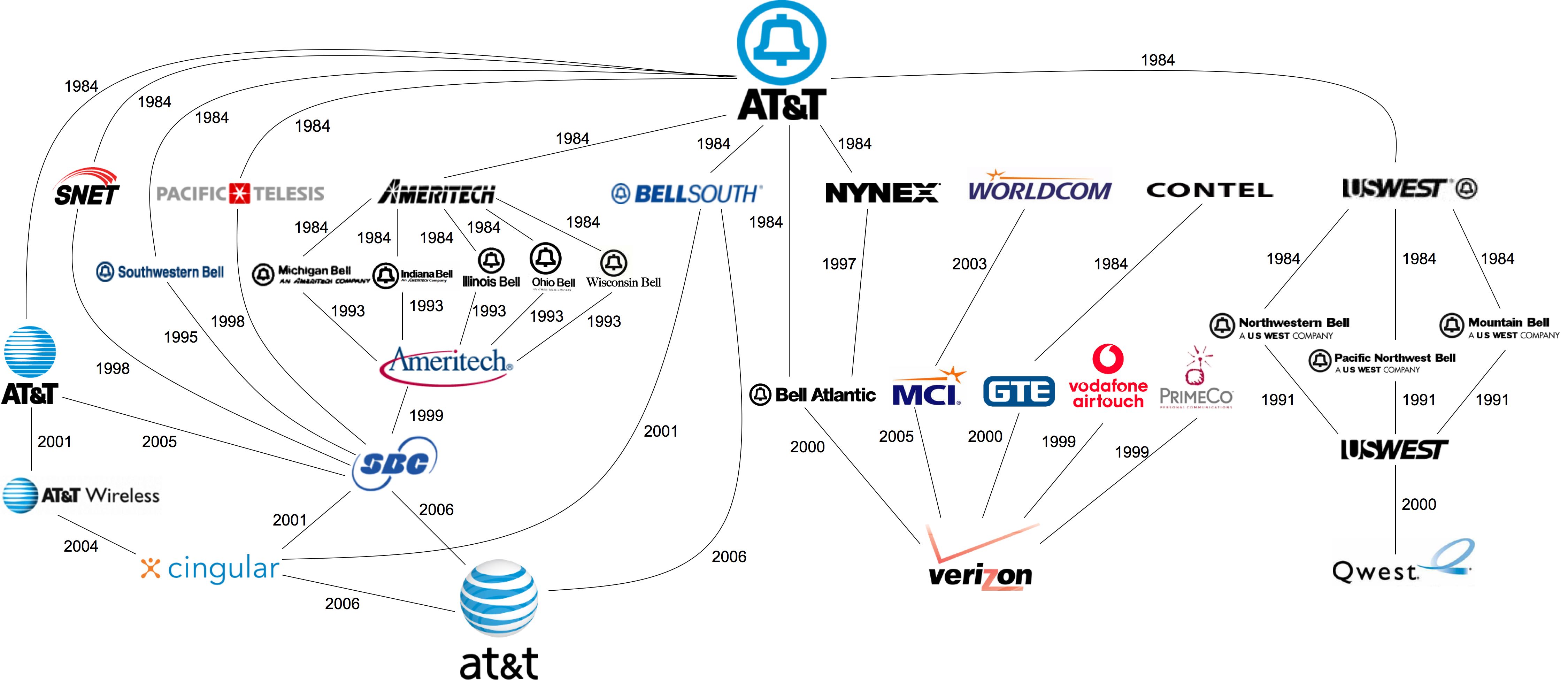
I'm actually curious about how the current situation arose. We clearly have some historical trust-busting (e.g. Bell, as the article points out), but the concentration of market share in a ton of industries is pretty obviously too high, and basically nothing seems to get done about it in at least the last decade.
It leads me to believe that much broader criteria and lower thresholds should be applied when assessing monopolistic organizations. Honestly I'd even argue that a measure of total organizational complexity or size, like number of employees or percent of GDP controlled by the company might warrant nipping a potential runaway monopoly in the bud.
True. Our economic system doesn't set an upper limit on the size or amount of wealth any company/person can reach, and since wealth is made of resources and resources aren't infinite, we have a big problem here. Any company anywhere is going to become a bad player one day because of the lack of such a limit.
Unfortunately thanks to bribery, be it legalized (lobbying) or not, the same people who should implement a limiting system are "discouraged" to do so by the same people/entities they should control, or even worse, they're the same people.
Microsoft doesn't get any special mention :p. Makes sense to leave Microsoft out in 2017, but Apple doesn't really have a monopoly ripe for abuse either in the same way of Google, FB, Amazon. If Apple is included because of its size, then Microsoft still does more revenue and profit than most of the tech companies. And its market cap will be higher than Amazon and FB for a few more years.
Apple could be included because of their astoundingly revolting behaviour. Microsoft never pulled a "You write a program that runs on windows we'll take 30% of your revenue off the top or we block your sales" stunt.
Literally the only thing that has ever made apple less awful than microsoft is their lack of success. I would miss them no more than microsoft if they died in a bankruptcy event redolent with the kind of fraud they think is "good business"
Kid, when I started in software development we had to give 50% of our revenues to Ingram-MicroD, plus co-op (marketing) dollars, and pay for printing manuals, boxes, copying disks, and shrink-wrapping out of the rest. Then with what was left we'd pay for advertising, development, and support.
Apple created a market where they host all of your content, give you your own free marketing pages for each product, pay for all the costs of distributing your content world-wide, and pay developers tens of billions of dollars a year. That they only ask 30% is one for the greatest deals software developers have ever had.
The issue isn't whether or not 30% is a reasonable amount. The issue is that no one else is allowed to compete with them to do it better or cheaper. Maybe someone else wants to take a 70% cut will do such a fantastic job of marketing that it would be worth it. They should be allowed to do so. Maybe some larger app developers want to handle distribution and marketing in-house. They should also be allowed to do so.
The freedom you want is called jailbreaking. Stores created for it never found much success. Or you can build android or web apps, and find similar freedoms.
Apple built a huge market in part because they provided security and quality. iOS Customers like that Apple vets iOS apps so much more rigorously than Google Play and other Android stores.
You want to take advantage of the huge market Apple built so carefully, by having Apple throw out all those protections for you. Or you want to take advantage of it while denying Apple any of the revenues. Both are cluelessly self centered and selfish.
Oh great. They let people do it in the tiny portion of the market that is normal desktop apps. They still keep a tight leash on the much larger mobile app market.
The counterargument to this is that Apple does not have a monopoly, or anything even close to it, even in the mobile device space. It's of course the most profitable company there, but its Android competitors sell far more phones than they do, even if you look only at the US. IMO, this basically means Apple's high fees are a "stupid tax" for Apple customers. If you don't like their policies or prices, don't buy an iPhone, it's that simple.
Of course, this might leave you single and lonely, since studies have shown that women are more likely to discriminate against potential suitors based on their choice of phone (if a man doesn't have an iPhone, or their iPhone is too old, the women isn't interested). But this can be a useful way of screening out superficial people who spend too much money and will end up spending you into bankruptcy if you marry them.
BTW, MS is trying to copy them, with Windows 10S and their policy that only software from the Windows Store will run on it.
I am curious how can you even break Google apart -- it is not like you can just split it into regional companies (like with Ma Bell). The article only mentions:
- Fining Google over shopping-comparison results
- Forcing Bell Labs to license its patents to all comers
I don't think that the fines could reduce Google's or Facebook's market share in their primary market.
As for the patent example, I am not sure how to apply it to Google/Facebook. AFAIK, their patent portfolio, or even their software, is not the key to their success -- their social networks are.
At least they are only a monopoly in one relatively small sector. They have 1/3rd the revenue of Facebook, 1/10th the revenue of Google or MS and 1/20th the revenue of Apple, and unlike those companies, they probably won't be able to leverage their monopoly to gain a huge advantage in other sectors.
The technopolies bring greater efficiency and common platforms along with the unfair business situation.
The trend is towards more consolidation morphing into a type of technocracy. This is basically technological communism. The biggest problem with both capitalist and communist systems is over-centralization.
There are quite a few technocrats out there and people that don't know they are. They will run up against the problems of over-centralization and have their models fall apart.
We can look at the platforms built by companies like Uber, Amazon, and Google as centralized testbeds for the decentralized platforms that will replace them. We must have common platforms for compatibility and efficiency and data sharing. But we cannot allow companies to control them and use them to dominate markets in ways unfair to employees, other businesses, and eventually even consumers as their monopolies grow more absolute.
Adoption of decentralized platforms is the next step. These platforms must provide some type of holism while at the same time being able to evolve freely.
> "They don’t engage in the predatory behavior of yore, such as selling goods below the cost of production to steal market share and cripple competitors."
Uber (and presumably Lyft) does the same -- the theory being that they can destroy taxi businesses, then set their prices at anything less than a towncar service.
good background reading is the book "The Master Switch" by Tim Wu. Places current monopolies in historic context. doesn't give them a free pass mind you, just lets you see that monopoly is a very stable and self-perpetuating state of affairs. reminds me of punctuated equalibrium theory.


This line of thinking is how you end up like Europe that today consumes goods and services produced almost entirely by large US tech companies. If you handicap the American tech giants this way, prepare for a world where the only remaining tech giants dominating globally are Chinese, Korean and Japanese (it wouldn't be Europe because Europe has already handicapped its businesses).
I'm honestly amazed that most people that don't realize that your country's businesses are in competition with all the businesses of other countries. A well meaning policy that would be good for your nation pre-globalization will handicap and disadvantage your country's economy now that globalization is the status quo.
Economic nationalism is a prerequisite if you want to live in an economically prosperous nation.