>> Pretty much everyone prefers a nonstop flight—business people, especially.
Is this true? I find it so hard to sit in the plane for such a long time. I don't think flying in business class would make too much of a difference because it is still way more constrained than outside a flight.
Modern business class is a different world. There's space to stretch out, kick back, sleep, food is often served on demand, etc. On more than one occasion I've found myself at the tail end of a 14-hour flight and wishing we weren't landing just yet.
Having flown Sydney to New York and back just last week, I would much prefer a single non-stop flight. Especially since on the way back I missed my connection in SFO due to bad weather and was stuck for a full day: all US West-Australia flights leave late at night, so if you miss one wave, it's 24 hours until the next batch.
Also, 20 hours seems like a lot, but it's only an incremental increase on the current longest flight (17:40 for Doha to Auckland, NZ on Qatar) or the previous longest flight (18h+ for Singapore to NY). The problem is really the economics and the rocket problem: to fly further nonstop, you need to carry lots of fuel, which increases the weight, which requires more fuel... The 18 hour flight was business class only with seats going for north of $10k return and Singapore Airlines still couldn't make it pay off.
While boarding a flight this week, I was told to wait (just entered the plane) because they wanted to serve orange juice to someone in business class. So me and some 10 people behind me waited until the air hostess served the juice and came back few mins later, because orange juice couldn't wait for another 15 mins. It felt very weird. I guess rich people do really experience life on a different level.
International upgrades still tend to require fairly substantial co-pays. Nothing like paying the whole thing in cash but still in the multi-hundreds of dollars.
That depends, I recently booked a "round the world" trip in first class with miles (total distance traveled 19500 miles and 5 different cities visited so not really round the world) and in total I only paid 400 usd in taxes and fees and 205,000 miles.
If you can get the miles from churning, I wouldn't say that the co-pay is particularly onerous, it's much less than it would have cost to buy all the tickets in economy.
That's pretty good. United is around $500 one-way for trans-oceanic upgrades to business plus around 25K miles. A pretty decent bargain over just buying a business class ticket but not a trivial cost either. I do it now and then but I'm selective.
I've flown company-paid business class flights that cost something like 5% of my pretax income. Who spends 5% of their income on a weeklong trip multiple times a year?
I typically decline the pre-departure beverage when flying up front, and honestly on a lot of US airlines these days it's inconsistent as to whether it's even offered. So both I and flight crews are trying to avoid inconveniencing you :)
Also, on international flights this won't interfere with the boarding process, because usually they either board using multiple doors (one for business/first, one for economy) or they board from a door behind the front cabin, so that people in first/business turn left to get to their seats while people in economy turn right. There are some studies suggesting that if people don't have to walk through and see the fancy cabin on their way into the plane, they get less angry in the economy cabin.
That said, yes, it's a very different world. I've done international flights in economy, and suffered. I've also done them in business class, and was fine. Getting a good night's sleep over the ocean, stepping off the plane into fast track through immigration, then into a lounge for a shower and a hot breakfast, makes the process not only bearable but pleasant.
And that's without getting into the ultra high end of airline travel (which is still well behind what you get once you're into private-jet money). Look up some videos of, say, Lufthansa's first-class terminal in Frankfurt. It's literally a separate terminal for the first-class passengers, with private security screening, private passport control, private dining and relaxation areas, and then they put you in a chauffeured luxury sedan and drive you across the airport to your gate, where you take an elevator up and board the plane, never having to mix with the economy-class passengers at all.
The middle eastern carriers are like this, too, and many go so far as to send a personal driver to your home or hotel to pick you up and make sure you reach the airport in time, and have staff who whisk you through check-in and security and into a private lounge to wait for your flight.
Currently Etihad has the fanciest in-the-air setup, with two different first-class "seats" on their A380s, both more or less private airborne apartments (one of them is literally called "The Apartment", the other is a multi-room setup called "The Residence"), with your own private butler, access to a shower in flight, etc.
Alternatively, he/she might have known that ordering orange juice at that moment would hold people up and derived pleasure from knowing that was occurring.
Flew Aegean Business Class earlier this summer. As you get off the plane, there is a bus waiting outside only for BC passengers. Economy is let off the plane once the bus has departed. Felt a bit strange yes, especially if you are alone in that bus. I don't mind being treated well, but preferrably not on expense of others :)
Yep. I've flown a few 14+ hour ultra-long-haul flights in business or first class and it's a pleasant enough way to fly. Key for me is to shower at the lounge before departure. That makes a big difference in comfort.
Since I started hiking and multi-day backpacking trips I've found it much easier to enjoy myself while being dirty (amongst other slight inconveniences like being hot, sweaty or attacked by bugs). Might not be ideal for those around me but I'm now more comfortable on long trips/flights even if I don't get to shower right before/after.
As well as the physical and mental benefits of being clean I find it also gives one a chance to get some much-needed isolation away from one's fellow travelers for even a few minutes. I quite enjoy flying - am about go from Tallinn -> Frankfurt -> Singapore -> Adelaide - but interacting with people I don't know I find very tiring. It's one reason I much prefer travelling with my wife; our shared 'personal space bubble' when seated together is much bigger.
Am really looking forward to the shower in Singapore after a 12.5hr flight!
If you are in economy you have seat neighbours - you have to ask permission to get up from your seat for example (or have others asking you). It happens occasionally in business class too.
Also, showers usually do more than just getting one clean. It could be psychological, but I find showers help me to relax, de-stress, and prepare me for sleep. Of course I'm one of those folks who shower before bedtime, so your mileage may vary.
It's in the paid lounge (you don't have to pay for entry to the lounge though). Definitely recommended as well. Or if you're there for long enough, try the swimming pool.
That depends very much on the kind of aircraft, and while there are aircraft for which this is true this definitely isn't always the case. Modern aircraft are miracles of efficiency.
Most fuel is used to haul the airframe, cargo and the passengers around, fuel is only a relatively small percentage of the total maximum take off weight.
For example, the A350 mentioned in the article has a maximum of 108 Tonnes (140K liters) of fuel on board and has a maximum take-off weight of 280 Tonnes. So no matter what the mix cargo/passengers/fuel is there will never be more than 30-40% of the take-off weight in the fuel, and a good chunk of that (5 - 7 Tonnes) will be burned just on take-off and another 5-7 Tonnes to get it to altitude. So fully 10-14% of the fuel will be gone after the first few minutes of flight, then once you reach cruising altitude the consumption drops quite a bit due to the reduced drag.
Consumption during take off and getting to altitude varies between about 2.5 and 1.0 times consumption at cruise altitude due to increased drag and the climb itself.
With that kind of penalty on a take-off and the required reserve on landing (which is usually dead weight, but which you will very much appreciate if you have to get to your first or second alternate) the overhead of a landing+take-off sequence is pretty stiff so non-stop flights have a good chance of being more efficient if the destination is in range.
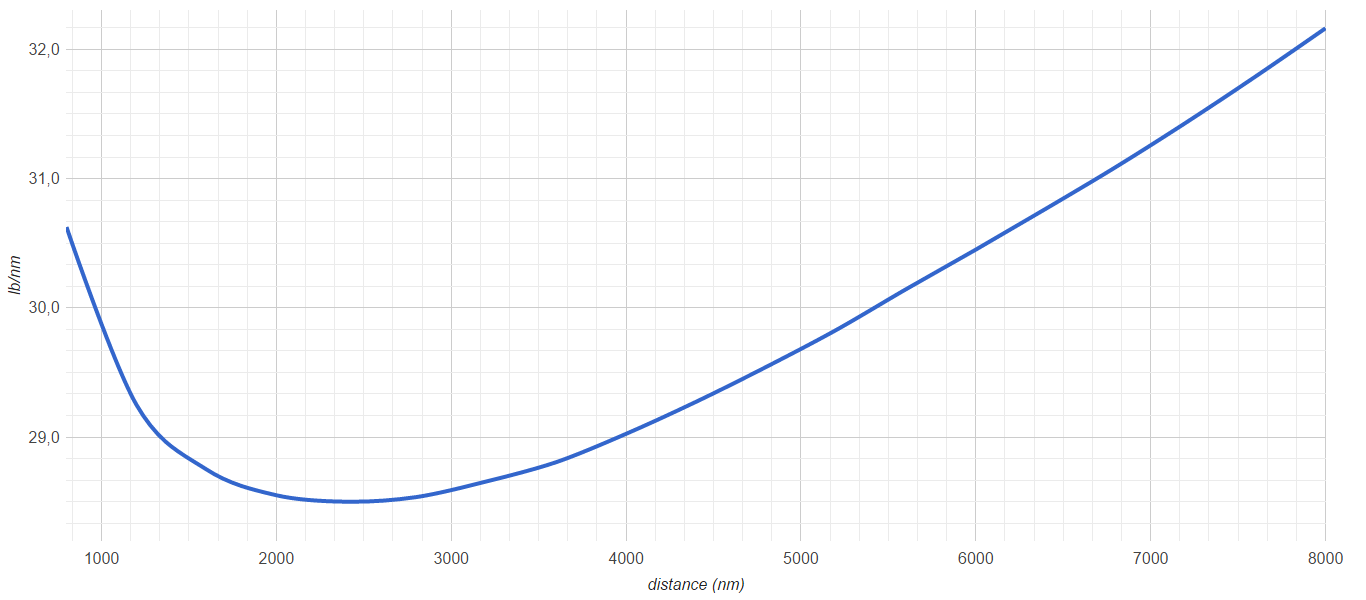
You are completely ignoring the cost of cycling an aircraft, and that pretty graph is less than 10% spread from min to max efficiency. So no, you will not be better off landing.
Maximum efficiency merely indicates at which distance all parameters are matched most perfectly, it is not the distance above which one should land to take on more fuel to be more efficient.
Reduction to absurds is an easy way to prove that to yourself, imagine a flight of 3000 miles at maximum efficiency, and then one at 3001 miles at which you claim they should stop to take on more fuel. This clearly is not the case so there is something wrong with your statement.
Just to nitpick a little: The peak efficiency seems to be around 2500nm, and it's pretty flat between 2000 and 3000. Above 2500 nm, you have to compare to distance/2, since you compare between 1 and 2 legs. Example: compare the efficiency at 3000nm and 2*1500nm. The cutoff is slightly higher than 2500nm. But not far from 3000nm. Coincidentally London-NYC is 3000nm. So anything longer than that could be split off (if you don't take a detour to do so).
My sister used to work for United a couple of years back as ground crew at a small airport that flew directly to SFO. She always told me how notorious SFO was for weather problems, and would cause flight delays or cancellations day-to-day (multiple times a week) with only a couple of hour's warning.
SFO's issue is not "weather" so much as it's a combination of the local conditions and the airport itself.
SFO has two sets of parallel runways, and usually likes to use 28L/28R for arrivals. There are plenty of protocols for airports to do simultaneous landings on two runways parallel and next to each other, but (simplifying a bit) SFO has the slight problem of them being too close together to do instrument landings for both runways at the same time.
This leads to compromise protocols which rely on the ability of one plane to maintain visual contact with the other plane when doing simultaneous landings. But of course in foggy/cloudy/rainy weather, visibility goes away and SFO can no longer handle simultaneous landings on those runways, which basically cuts the capacity of the airport in half.
I've never flown business class, but I'm from Australia and currently studying in the UK. When flying home, I generally try to find a 2-stop flight, which gives 3 7-ish hour flights, instead of the 14-15 hour leg on a one-stop.
Me too :) often same price with Qantas to do PER-SIN-DXB-onwards instead of PER-DXB. And Singapore is the best airport.
Business class any day but 19hours non stop in Economy is pain for me. (Which the new PER-LHR is).
It makes sense for Qantas though it's mostly the only way to fly more long haul flights competitively because all the flights are too long like this. And saves you airport fees for the stopover.
> I find it so hard to sit in the plane for such a long time.
The 14.5 hour flights I have taken were certainly more tedious than individual 7 or 8 hour flights. But back-to-back 7 or 8 hour flights plus an hour or two layover is much more tedious. Whenever possible, I would rather do a single flight.
If you have multiple flights, there's always stress that you might miss a connection. And you can spend every flight worrying that you might not catch the next one. When you board your last flight, you know you "made it", you know you're gonna get to wherever you're going, and can spend the entire flight relaxing.
If you have a single flight, you get that feeling of being done once you board your first flight, there's just fewer opportunities for stress.
It appears I have accepted the usual stresses and matters of courses of flying as normal and in doing so have become a grateful sheep.
Then again, the times I've had to worry about missed connections are small and the rest didn't end the world; the worst I've had to experience is waiting longer than expected.
> What makes it more tedious, the sense that you're meandering around an airport in "dead time"?
Partly what henrikschroder said, but it's also the trip just takes longer with a connection. And after being on a 7 hour flight, I never look forward to getting back on another one. Also I typically have to go through customs and immigration in the stop between the two long-haul fights, so that adds a whole additional level of hassle that would be avoided with a direct flight.
Current longest non-stop commercial flight, Air India DEL to SFO, has been very popular and often operate at 85% capacity 6 times a week[0][1]. Air India is adding DEL to LAX non-stop next month. It's especially popular with elderly travellers, as there's no hassle of transit.
AI173 DEL-SFO uses a strange routing to produce a slightly longer distance than QR921 AKL-DOH -- literally, it's routed to be just 50 miles longer by distance flown.
But by time in the air QR921 is still the longest flight in the world (17 hours 30 minutes, compared to Air India's 16 hours 55 minutes). Five other flights also are scheduled for 17 hours or longer in the air: EK449 AKL-DXB; UA1 and SQ31 SFO-SIN; QF8 DFW-SYD; and AA125 DFW-HKG.
> It's especially popular with elderly travellers, as there's no hassle of transit.
That, and the fact that there are a lot of Indian elderly who make the Delhi-San Francisco flight regularly to visit children who work in the Bay Area.
For business, you are flying to make money. A missed connection due to a slight delay could turn it into a 24 hour delay, and therefore a missed opportunity to make money.
Of course, I don't know if the stop overs for refuelling involve a connecting flight or if you are put back on the same plane, so in those cases (where your are guaranteed a rest stop of no more than 3 hours) I can see the preference going ether way.
Many of those flights even with the same flight number often have you deplaning and transferring to a different plane. But not always.
The reason for this partially is old airline freedom laws. Because stopovers used to basically be required for all long haul flights in 70s etc you can "stopover" in other countries airports.
The rules around flight numbers are, in simplified form, that the airline can use a flight number once per city pair per 24 hours. This allows reusing a flight number -- possibly with a different plane -- on a later segment, which is a concern due to flight numbers being limited to four digits via legacy systems (airlines with lots of regional affiliate and partner codeshare flights literally risk running out of flight numbers!).
In the US, larger airlines often use a flight number twice a day -- once for a domestic flight and once for an international flight. For flights departing to international destinations, it's not uncommon for one of the inbound feeder flights to use the same flight number.
Also, for a foreign carrier, the rules are a bit more complex; they can make an additional stop in the US, and can pick up more passengers, but can't do much more than that. US federal law requires that transportation between two points in the US take place on a US-owned carrier. So, for example, Qantas flies from New York to destinations in Australia with a stop in Los Angeles, and can pick up more passengers at LAX and even change planes there for the onward journey, but they can't sell JFK-LAX tickets.
You can get up and walk around during the cruise phase. I vastly prefer direct flights, even for long trips. (For example, I fly Washington to Beijing every couple of years, and try hard to get a direct flight for that.) Changing planes adds so much time, and is stressful for international flights where you have to clear customs before when making the connection.
A non-stop flight means you only have to deal with CBP or TSA once, at the end of the flight. If you fly SYD-LAX-JFK or SYD-DFW-JFK you have to get off the plane at LAX or DFW, go through immigration and customs, go to the domestic terminal, go though TSA security and hope you have not missed your domestic connection.
Most major international transfer airports (e.g. Narita, Hong Kong, Schiphol, Changi, even Moscow) have nice air side connections that don't require entering immigration. Ya, they'll still security screen you, but it is much quicker than when initially broadening.
America is unique in requiring all passengers to go through immigration, but in that case they are usually going somewhere else in America anyways so it would be a port of entry. Sucks if you are transferring in Miami to go to South America, however.
And China is interesting in the other direction: certain cities in China allow multi-day "transit" without a Chinese visa, so long as your origin and eventual destination are two different countries. So, for example, you can fly into Shanghai from the US, spend a couple days there, then board a plane to Tokyo, and China considers it to be one long "transit" not requiring a visa.
Extended stay transfer visas on arrival are not uncommon. Moscow has this, as does Hong Kong for mainland citizens without entrance permits. So if you fly to Europe from Asia via Moscow and have an extended transfer Moscow, you can get a visa on arrival to see the city for a day or two, or if you are mainland Chinese and fly to Bali via Hong Kong, you can have a one day layover and see Hong Kong even without a Hong Kong visit permission.
You can add doha to that list, they often do security screens but not always... An hour has been hurried/comfortable connection time multiple times, even made 50 minutes a few times. YMMV.
The few 14+ hour flights I've been were more comfortable than the usual connecting flights I take for the long haul and ultra-long haul trips. Not sure if the longer haul flights have more comfortable seats even in economy but leg room and width were ample. They were all 777-300ERs. I prefer them over having to go through another airport (security) and chances of delays for the connecting flight.
I don't, even in business. I flew to HKG last week via Helsinki and Bangkok; not only was it cheaper because 2 stops but we had 1 full day in Helsinki and 1 full day in Bangkok which made my jetlag, landing in HKG non existing and gave us time to visit friends in both cities.
On a long flight I take a few walks, loiter in the galley area, get the blood flowing in the legs with a session of raising myself up/down on tiptoes repeatedly... Really seems to help.


Is this true? I find it so hard to sit in the plane for such a long time. I don't think flying in business class would make too much of a difference because it is still way more constrained than outside a flight.