Sun cheaped out and didn't put ECC on the cache of their very expensive UltraSparc servers. I suppose the outrage is pointless now that they are gone, but it was a ridiculous cost cutting measure on a very expensive piece of hardware.
IBM did a lot of the early research in my hometown on cosmic ray errors. It essentially said that you were 5x more likely to see single bit errors in Boulder, Colorado than NYC, and ten times more likely in Leadville, Colorado. It was mostly due to the altitude differences, Boulder being approx 1 mile up, and Leadville being two. The latitude also mattered, though: La Paz is even higher, but is further away from the poles, so it was a safer place to put your data without ECC.
I remember how our Sun representatives would go to almost any length to avoid admitting a hardware problem. Instead they tried to blame the problems on cosmic rays or the fact that the servers wasn't running in an environment with a very narrow temperature and air humidity window.
Funny how they wouldn't admit to a hardware problem but still had data that showed that the problems were less likely to surface if the temperature and humidity was X and Y..
I wonder if it'll get bad enough to spur consumer hardware to switch to ECC. I can't believe the price difference is very significant, especially if it starts being produced in even higher volumes.
Correct me if I'm wrong, but last time I looked into it, AMD's CPUs support unbuffered ECC RAM, which is really hard to come by and much more expensive than the usual buffered ECC RAM.
True, but it seems unlikely that there's a fundamental reason why unbuffered should have a higher manufacturing cost. It seems to just be an accident of history. Thus,
maccam94's point still stands.
Tangentially related, taking a Geiger counter on a trans-Atlantic flight is a pretty good time [1]. Some good low-dose radiation data we have comes from flight crews.
> The problem is, as the authors note in their new paper, the shield is weakening: “Over the last decade, the solar wind has exhibited low densities and magnetic field strengths, representing anomalous states that have never been observed during the Space Age. As a result of this remarkably weak solar activity, we have also observed the highest fluxes of cosmic rays.”
The earth’s magnetic field has fluctuated and reversed throughout geological history. Recently, the field has been decreasing in strength and may be poised for a reversal. It’s bad timing insofar as it coincides with an impending solar minimum.
Magnetic field reversals happen on a completely different timescale than solar minima/maxima. Reversals take a long time to happen: ~1 to 10 ky. Quick on a geological timescale, though.
from TFA, it seems all of the increase is explained by the dud maunder maximum of the past few years. the magnetosphere and atmosphere are unaffected, but more rays are getting through the weakened solar wind. they anticipate a record-setting maunder minimum in 2019-2020 that will intensify the problem
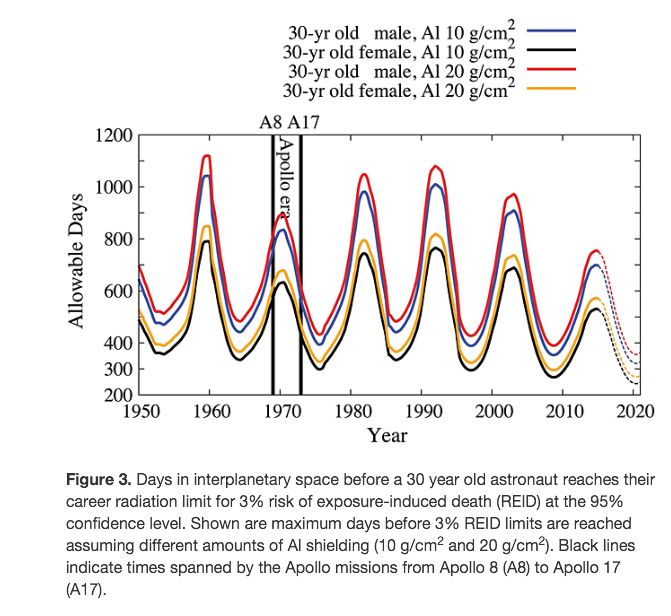
Tangential question, but does anyone have any idea why, based on the first graph in the article [1], NASA's allowable radiation limits for women are so much lower than for men?
In vertebrate females, all oogonia mature to oocytes before birth. In males, spermatogonia mature to spermatocytes continuously after puberty. I gather that oocytes and spermatocytes are more sensitive than spermatogonia to radiation damage. Damaged spermatocytes and sperm get replaced after a few weeks. But there's no replacement for damaged oocytes.
I just had the horrific thought of what if some nearby interstellar event zaps all of earth with a deadly blast of fatal radiation killing all life in a matter of days. Is this possible and is there anything in the archaeological record hinting this may have happened?
> "The movement [of the Milky Way] is not edge-on like a Frisbee," Melott noted. Instead, he said, it is flat, "like a pie in the face."
Huh, I didn't know that, and now I have a great mental picture to accompany that fact.
For anyone who skimmed and is wondering "How long before another mass extinction, according to this theory?", the answer is in the last sentence (on page 2): we've still got 10 million good years.
I remember learning about this. I wonder if Earth was enveloped in such a burst, if we'd go out quickly, peacefully, like a heart attack in our sleep. Most life wiped out on our planet in an instant. It makes you wonder how many world out there contain the empty structures of civilizations that went out in an instant, with a whisper.
I think that on average, there's a GRB close enough to us to matter once every billion years or so. However, it'd still need to be aligned perfectly to hit us, making the actual extinction event far less likely.
Cosmic Rays that hit earth are very likely to also hit Mars, at the usual large distances they can cover a couple light hours of diameter. I would recommend colonizing at least 4 solar systems no less than 10 lightyears apart to avoid any and all possibility of a GRB/CRB lining up a shot.
That won't help. The closest GRB we've detected was about 100M light years away, so well outside the galaxy. If we had one happen within our galaxy that's beamed towards us, I don't think that 10ly make any practical difference in the 1/r^2 attenuated flux. Also, the beams are thought to be several degrees wide, so unless it's a very close GRB (in which case we should consider other problems), it's also unlikely that 10ly would move is out of the beam.
Source: former astrophysicist. Also if I remember correctly, the Wikipedia article on grbs is actually decent. (Edit: overstated things - need coffee, I suppose)
Still an astrophysicist. I'm a Computer Scientist. I won't cease being one even if I change professions, I will just be whatever I become in addition to a CS.
This is true and possibly one reason I think moons are a better bet for cosmic colonization.
Mars, venus, and mercury have next to no field, earth has a moderate field, and all our gas giants have very strong fields.
Some of the gas giant moons are attractive since the gravitational effects on the moons can create geo-thermal energy. Pair a large planet with a strong magnetic field and energy created from gravity and we might have something interesting worth exploring.
I do not think this is perfect though, due to the size of our atmosphere we are shielded from meteorites,, this might not be the case of these moons. We would need to consider making some way to protect ourselves like harvesting ore from surrounding areas. Even then this might not stop large collisions.
You know what's even better than dirt at stopping radiation? Water. And we have lots of it. 10km of water at the bottom of the Mariana trench should stop any amount of radiation that could hit Earth.
Both require living in some sort of pressurized container, unless you assume we could live in underground caves(but those can't be very deep so probably not good enough). Obviously the underwater one would require more engineering, but probably still less than one needed for Mars.
That depends on your perspective. We have the technology to go to Mars right now; we do not have the technology to go to the bottom of the Marianas Trench. It is a much more hostile environment than Mars is.
However, if you assumed that we were able to go the bottom of the ocean, transporting supplies there would be much easier than transporting supplies to Mars.
My Inc. article asks why we think we will solve problems off Earth that we haven't on Earth. Or if we think we can solve them there, why don't we solve them here first?
If we want to get to Mars, probably the best start is to solve the problems we have here first.
The problem with this argument is that it is a false choice. We do not need to choose between fixing our planet and expanding into space. There are seven billion of us, and collectively we’re not that bad at multitasking.
Furthermore, it is a straw man, because nobody actually believes that we should give up on Earth. You cited a number of headlines attributing this position to people like Elon Musk and Steven Hawking, when a quick reading of their actual quotes shows that they do not actually say what the headlines claim (Musk also runs a clean energy company for Pete’s sake—doesn’t sound like he wants to give up on Earth). I really want to believe that you wrote your article in good faith, but that means I must believe you did not read the articles you linked as evidence.
Fixing problems on Earth vs colonising Mars is the difference between carefully maintaining your family PC and buying a second one so you still have a working one when the first one breaks down.
Redundancy doesn't fix problems but it cushions the failure case. There are numerous ways Earth could be wiped out in a way we can't defend against.
I see this phenomenon quite a lot, even on HN. Supposing we find a planet that is conducive to life, how can we avoid exporting all of humanity's cultural and biological baggage to that new civilization? Aside from the exploitation and near-genocide that took place in the Western hemisphere, how is it really any different that the opening up of those continents, but with a bigger ocean between? I've seen other discussions try to route around this question by talking about Mars or some other hostile environment as perfect for the type of co-operative commune they imagine humanity could be, one where people must rely on each other or die. I don't see a qualitative difference between that environment and the deserts of the American West, where the climate was harsh and water scarce.
Those migrations didn't bring utopia, either to the participants or the rest of humanity.
I agree that utopian predictions have a long history of failure and should be taken with a Mars-sized grain of salt. However, I would argue that the difference is that there is not likely to be complex life on Mars or any other location in our solar system. This makes it quite a bit different from the North American example, in which immense suffering was inflicted upon the existing inhabitants of the region. If any planet or moon was found to contain life-forms capable of experiencing suffering, I and (hopefully) most people would be against human settlement there.
Not a significant difference in safety between Mars and Earth when it comes to interstellar sources of radiation. In fact Mars lacks a magnetic field and an atmosphere, two useful radiation shields here on Earth.
We'd do better to build out some element of human society underground, if interstellar radiation is our fear.
Actually, water is very good at stopping radiation, so if there was a massive gamma ray burst that killed all surface life on Earth, some small groups of humans would survive: deployed submarine crews.
Sealabs pose novel engineering challenges, could provide experiments in sustainable enclosed habitats, wouldn't risk microgravity or radiation, but would risk high pressures.
They'd also help species survivability in the event of some extinction-level asteroids, climate change, or interstellar radiation.
I think it's an even money bet whether it'd be easier to build a comfortable habitat for x people underwater or in space (for most definitions of comfort, x, and space).
Do cosmic rays that reach the surface leave any traces or make any changes that persist over geological timescales and can be dated, so that we can see how they have changed over very long times?